
The National Institute for Occupational Safety and Health (NIOSH) sets a recommended workplace exposure limit of 85 A-weighted decibels (dBA) across an eight-hour workday. For call-center agents who wear a headset through consecutive shifts, controlled output, speech intelligibility, and protection from sudden peaks matter as much as loudness.
We ranked these headsets using verified manufacturer specifications, platform certifications, microphone architecture, connection stability, comfort design, hearing protection, and battery performance. We did not invent listening sessions, laboratory measurements, or hands-on results where Headphones Pro Review (HPR) testing notes were unavailable.
The selection covers wired and wireless desks, home-based support, busy open offices, mobile agents, and mixed computer-and-phone workflows, with and without Active Noise Cancelation (ANC) or Universal Serial Bus (USB) connections for Unified Communications (UC) platforms. Agents who need a smaller alternative can also compare HPR’s earbuds for small ears, but a dedicated boom or business microphone usually gives call-center teams more predictable voice pickup.
Quick Overview for Call Center Headsets
| Overall Best | Jabra Engage 55 SE |
| Best Premium Option | Jabra Evolve3 85 |
| Best for Open Offices | ThinkPad Dual-Mode Wireless ANC Foldable Headset 8550 (Aura Edition) |
| Best for Home-Based Agents | Logitech Zone Vibe 100 |
| Best for Multi-Device Calling | Poly Voyager 4320 UC |
| Best Mono Bluetooth Headset | Yealink BH71 |
| Best Budget Wired Headset | Logitech H570e Headset |
| Best Lightweight Wired Headset | EPOS IMPACT SC 30 USB ML |
| Best for Unified Communications | Lenovo Wired VoIP Headset |
In-Depth Look: Call Center Headsets
1. Jabra Engage 55 SE
Overall Best
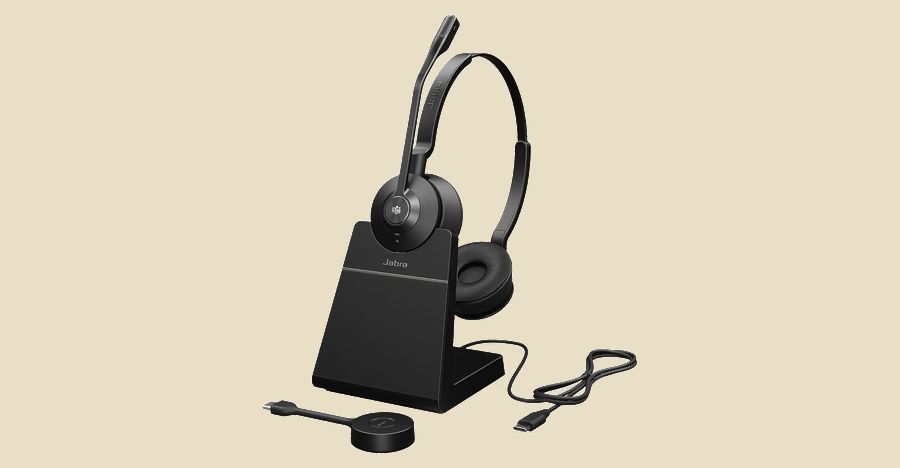
- Extends computer calls up to 150 m in direct line-of-sight conditions
- Maintains up to 13 hours of talk time with the busylight off
- Prioritizes vocal articulation through a 150 Hz to 6.8 kHz speech band
- Reduces outbound office noise through the stereo model’s dual microphones
- Supports major UC and contact-center platforms
- Single-computer connectivity with no simultaneous phone connection
- Complete absence of Bluetooth support
- Restricted 40 Hz to 16 kHz music bandwidth
- Premium pricing compared with basic wired headsets
The Jabra Engage 55 SE earns the Overall Best award because it combines long wireless reach, open-office microphone qualification, hearing safeguards, and dependable computer connectivity. Its Link 400 adapter uses Digital Enhanced Cordless Telecommunications (DECT), which suits dense offices with many simultaneous wireless calls better than ordinary Bluetooth.
The 150 Hz to 6.8 kHz speech band keeps voices centered and consonants prominent, while the 40 Hz to 16 kHz music range lacks the sub-bass depth and upper-treble air of a full-range music headset. At 83 g, the stereo version limits crown weight and sealed-cup heat, but its on-ear pads provide only moderate passive isolation. Nearby speech and keyboard noise can still reach the agent even when the dual-microphone system reduces those distractions for the caller.
The stereo and mono versions provide up to 13 hours of talk time with the busylight off and support charging during calls. SafeTone 2.0 adds peak protection and exposure management. The headset connects to one Windows computer or Mac through USB and does not pair with a phone.
View on Amazon: Jabra Engage 55 SE
2. Jabra Evolve3 85
Best Premium Option
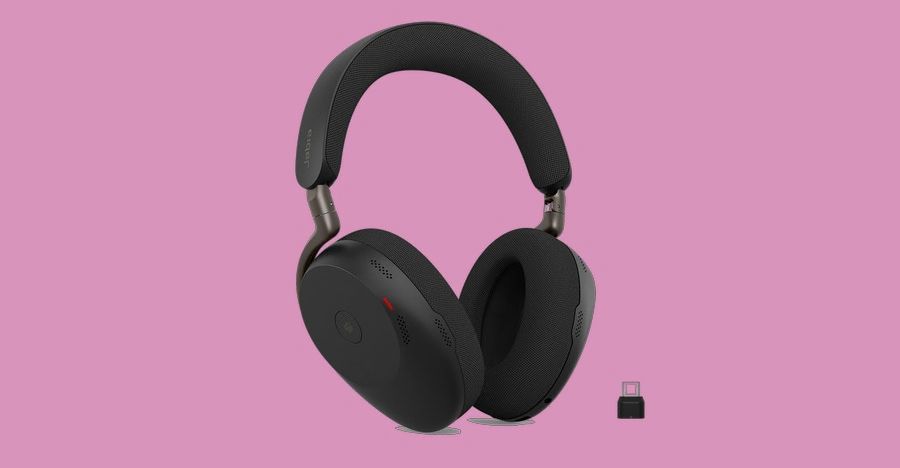
- Applies adaptive ANC during calls and media playback
- Uses six digital microphones for boom-free voice capture
- Supports up to 21 hours of calls with ANC and the busylight active
- Connects to two Bluetooth devices simultaneously
- Supports AAC, LC3, and SBC codecs
- High purchase price for large-scale agent deployment
- Heavier 220 g frame than lightweight contact-center models
- No adjustable boom for controlling mouth-to-microphone distance
- Unpublished frequency-response curve for assessing tonal neutrality
The Jabra Evolve3 85 earns the Best Premium Option award because it combines adaptive ANC, six digital microphones, full-range audio, and extensive battery life in a professional over-ear design. It suits supervisors and hybrid workers who alternate between calls, focused work, travel, and music.
Its 32 mm drivers span 20 Hz to 20 kHz, while the 100 Hz to 14.5 kHz speech band preserves more vocal harmonics than narrowband call headsets. Jabra does not publish a complete response curve, so Advanced Audio Coding (AAC), Low Complexity Communication Codec (LC3), and Subband Codec (SBC) support cannot prove neutral or bass-forward tuning. The 220 g frame and dual-foam fabric cushions distribute weight and vent heat, although full ear coverage can still feel warm during long shifts.
Adaptive ANC should reduce steady ventilation and transport rumble more effectively than speech or sharp keyboard transients. HPR’s Bose QuietComfort Earbuds II review explains how fit affects isolation, while the HIFIMAN Arya Stealth Magnet Version review shows why open soundstage alone does not determine call suitability. Battery life reaches 25 hours of calls with ANC and the busylight off, or 21 hours with both active, while Bluetooth 5.3, multipoint pairing, USB audio, a Link 390 adapter, a 3.5 mm cable, and a replaceable battery expand connectivity.
View on Amazon: Jabra Evolve3 85
3. ThinkPad Dual-Mode Wireless ANC Foldable Headset 8550 (Aura Edition)
Best for Open Offices
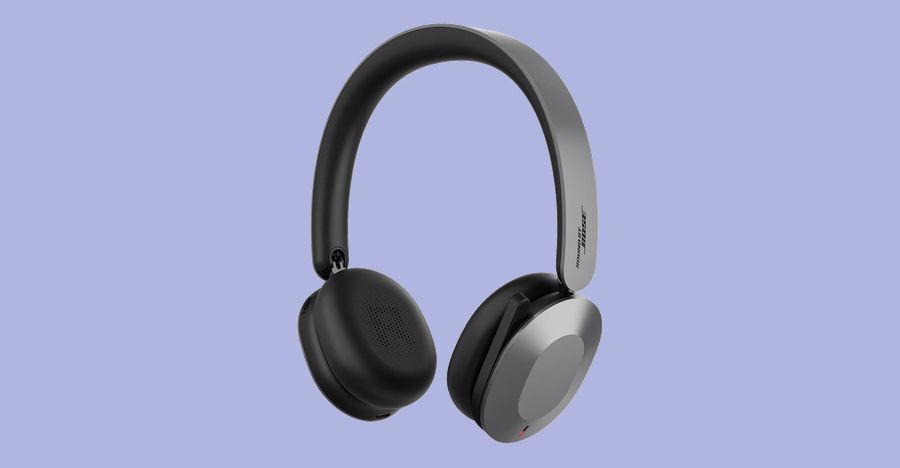
- Meets Microsoft Teams Open Office requirements
- Combines adaptive hybrid ANC with AI voice-noise processing
- Provides up to 24 hours of talk time and 51 hours of playback
- Connects through Bluetooth 5.3 or the supplied USB receiver
- Folds into a more portable shape for hybrid work
- New-model pricing above many conventional call-center headsets
- Limited long-term field history following its 2026 release
- No published frequency-response curve or detailed tonal measurements
- Aura pairing advantages depend on compatible Lenovo hardware
The ThinkPad Dual-Mode Wireless ANC Foldable Headset 8550 (Aura Edition) earns the Best for Open Offices award because its Microsoft Teams Open Office certification addresses microphone performance around competing conversations. Adaptive hybrid ANC controls incoming environmental sound, while Environmental Noise Cancelation (ENC) processing targets noise transmitted to callers.
Sound by Bose tuning does not establish a particular sound signature because Lenovo publishes no complete response curve or independent distortion data. Its foldable construction reduces bag space, but the unpublished cushion depth and clamp measurements mean buyers with glasses or larger ears should validate comfort before a fleet rollout. The full-size earcups provide more physical coverage than mono or shallow on-ear alternatives.
Adaptive ANC should work best against steady ventilation and low-frequency office hum, while Teams certification provides stronger microphone evidence around nearby speech than a generic reduction claim. Field agents who prioritize awareness and weather resistance can compare HPR’s earbuds for outdoor work. Battery life reaches 24 hours of calls and 51 hours of playback, with Bluetooth 5.3 and a USB receiver supporting phone and computer workflows.
View on Amazon: ThinkPad Dual-Mode Wireless ANC Foldable Headset 8550 (Aura Edition)
4. Logitech Zone Vibe 100
Best for Home-Based Agents
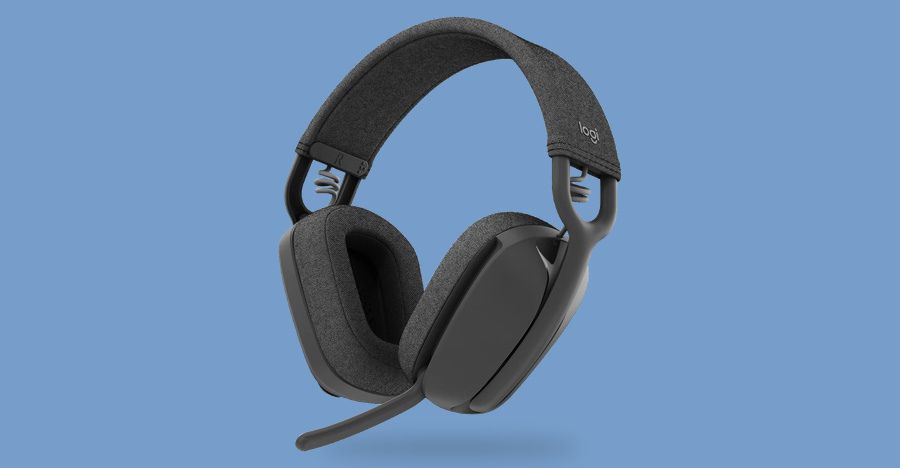
- Weighs only 185 g despite using 40 mm drivers
- Connects two Bluetooth devices through multipoint pairing
- Delivers up to 18 hours of talk time and 20 hours of listening
- Mutes the microphone when the short boom is raised
- Provides sidetone and EQ controls through Logi Tune
- Bluetooth-only audio with no dedicated USB receiver
- Complete absence of listener-side ANC
- Limited enterprise fleet-management functionality
- Soft fabric cushions provide limited acoustic sealing
The Logitech Zone Vibe 100 earns the Best for Home-Based Agents award because its 185 g frame, multipoint Bluetooth, flip-to-mute boom, and 18-hour talk rating support flexible work without enterprise-level cost. It fits quieter rooms where comfort and simple device switching matter more than maximum isolation.
Its 40 mm drivers cover 20 Hz to 20 kHz for music and 100 Hz to 8 kHz for speech, although the lack of a response graph prevents exact claims about bass lift, vocal recession, or sibilance. Fabric-covered memory foam reduces crown load and avoids the sticky feel of leatherette. The on-ear pads retain less heat than sealed over-ear cups but admit more conversation and keyboard noise.
Dual beamforming microphones and Digital Signal Processor (DSP) processing target outbound voice clarity, while the absence of ANC leaves household distractions audible to the agent. Bluetooth 5.2 supports a 30 m open-field range and two active devices, with 18 hours of talk time, 20 hours of listening, and one hour of playback from a five-minute charge. HPR’s best earbuds for small ears offers smaller alternatives, although true wireless models usually sacrifice a visible boom and physical mute control.
View on Amazon: Logitech Zone Vibe 100
5. Poly Voyager 4320 UC
Best for Multi-Device Calling
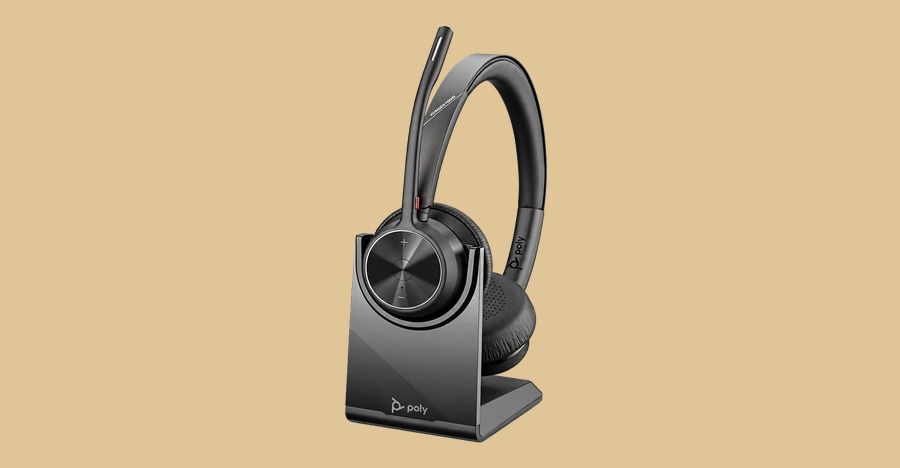
- Connects a computer through the BT700 adapter and a phone through Bluetooth
- Runs for up to 24 hours of calls with the online indicator off
- Extends wireless movement up to 50 m with the supplied adapter
- Filters outbound noise through dual-microphone Acoustic Fence processing
- Continues carrying USB audio when the battery runs low
- Complete absence of listener-side ANC
- On-ear pressure may affect sensitive users during long shifts
- Charging-stand configurations cost more
- Limited public disclosure of supported Bluetooth audio codecs
The Poly Voyager 4320 UC earns the Best for Multi-Device Calling award because it connects a computer and phone, supports long wireless movement, and continues through wired USB audio when the battery runs low. It suits agents who handle softphone calls, mobile escalations, and meetings through one headset.
Its 32 mm drivers span 20 Hz to 20 kHz, while the microphone focuses on a 100 Hz to 6.8 kHz communications band. Poly publishes no tonal curve, so the range cannot establish elevated bass, neutral mids, or relaxed treble. The approximately 0.35 lb on-ear frame limits total mass, but direct pad contact can create localized warmth and pressure during long shifts.
The headset relies on passive listener isolation, leaving ventilation, voices, and keyboard impacts audible, while Acoustic Fence narrows microphone pickup and SoundGuard Digital manages sudden peaks. Its BT700 adapter supports up to 50 m of open-space range and two-device connectivity. Battery life reaches 24 hours of calls with the online light off, 18 hours with it active, and 47 hours of music.
View on Amazon: Poly Voyager 4320 UC
6. Yealink BH71
Best Mono Bluetooth Headset
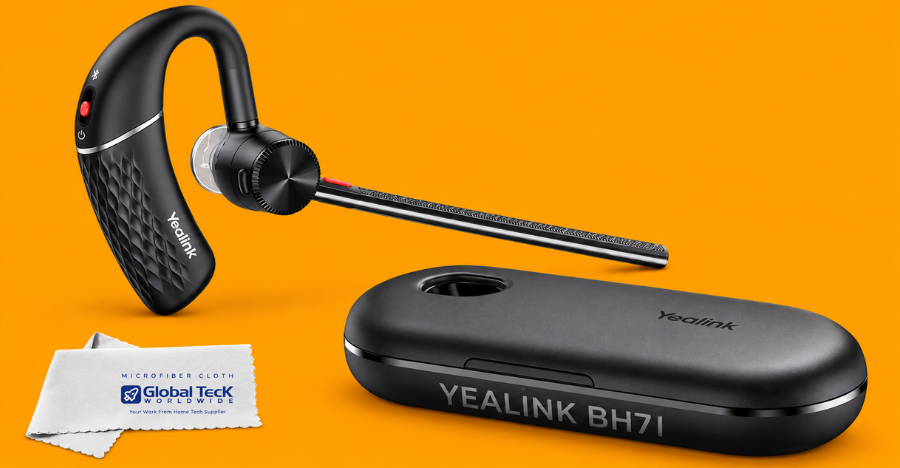
- Weighs only 18 g for minimal head and crown pressure
- Uses four beamforming microphones to focus on the speaker’s voice
- Reaches up to 40 m in ideal open-space conditions
- Provides up to 10 hours of talk time from the earpiece
- Adjusts through a flexible ear hook for left- or right-ear use
- Single-ear playback with no stereo soundstage
- Mobile-only connectivity on the base BH71 configuration
- Complete absence of listener-side ANC
- Carrying case with no built-in backup battery
The Yealink BH71 earns the Best Mono Bluetooth Headset award because its 18 g earpiece combines extreme portability, an adjustable ear hook, four-microphone beamforming, and a 10-hour talk rating. The lightweight structure eliminates crown pressure and full-headband heat, although comfort around the ear still depends on individual anatomy.
This mono design prioritizes calls and environmental awareness over music, so it cannot create stereo imaging or left-to-right instrument separation. Keeping one ear uncovered also prevents meaningful listener isolation, while the four-microphone array targets outbound background sound. Yealink states that it can reduce 90 percent of background-noise energy, but that manufacturer claim does not guarantee the same reduction in every environment.
The base BH71 connects to mobile devices, provides up to 40 m of range under ideal open-space conditions, and supports up to 10 hours of calls. Its carrying case protects the earpiece but contains no backup battery. Outdoor agents who need two-ear playback or a more secure activity-focused fit can compare HPR’s outdoor-work earbud guide.
View on Amazon: Yealink BH71
7. Logitech H570e USB Headset
Best Budget Wired Headset
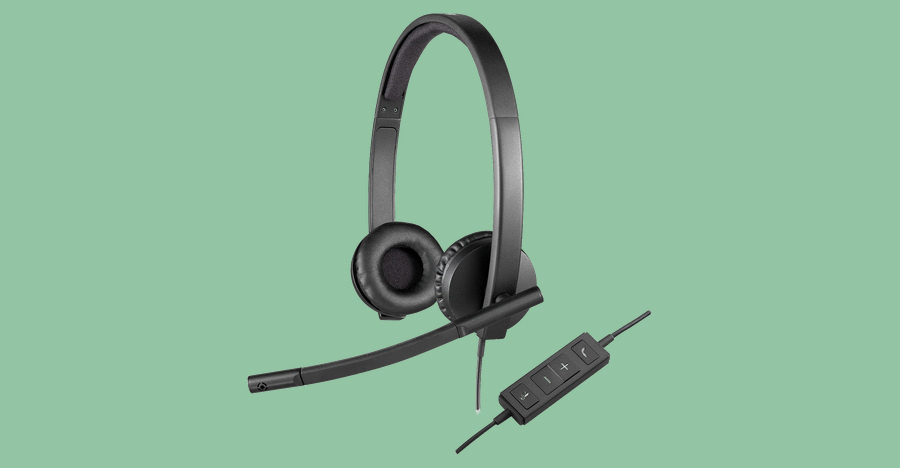
- Connects through a stable plug-and-play USB cable
- Uses 30 mm drivers with automatic call and music EQ
- Weighs 111 g in the stereo UC version
- Provides a reversible boom and replaceable leatherette earpads
- Protects against excessive output through European Standard (EN) 50332-2 compliance
- Fixed 1.9 m cable with no wireless mobility
- Complete absence of listener-side ANC
- Direct on-ear pressure from the shallow leatherette pads
- USB-A-only connection on the reviewed UC stereo version
The Logitech H570e USB Headset earns the Best Budget Wired Headset award because it provides stable USB audio, business-platform compatibility, replaceable pads, and hearing protection without batteries or pairing. This review covers the stereo UC USB-A version, model 981-000574, which matches the linked Amazon configuration.
Its 30 mm drivers span 31.5 Hz to 20 kHz, while the bidirectional electret condenser microphone covers 100 Hz to 8 kHz. Dynamic EQ adapts output for calls or media, but the headset favors intelligible speech over expansive imaging or forceful sub-bass. The 111 g frame limits crown load, although its shallow leatherette pads can create localized warmth and on-ear pressure during consecutive shifts.
The noise-canceling microphone and acoustic echo control reduce distractions transmitted to callers, but the lack of listener-side ANC leaves office speech, ventilation, and keyboard transients audible. The fixed 1.9 m cable prevents roaming but avoids radio congestion and pairing failures. EN 50332-2 compliance adds protection against excessive output.
View on Amazon: Logitech H570e USB Headset
8. EPOS IMPACT SC 30 USB ML
Best Lightweight Wired Headset
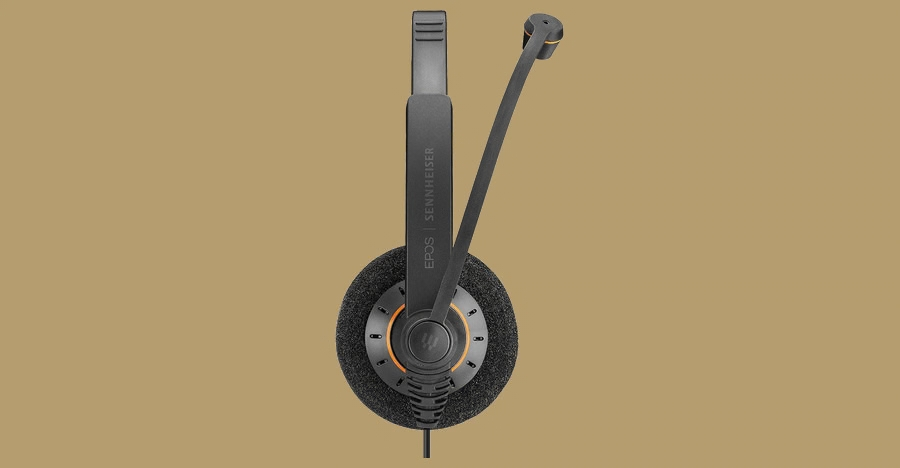
- Weighs only 42 g in its single-sided configuration
- Connects directly to a computer or softphone through USB
- Protects hearing through EPOS ActiveGard peak limiting
- Manages answer, end, mute, redial, and volume through inline controls
- Supports Microsoft Teams and major UC platforms after the required software setup
- Mono playback with no stereo positioning
- Narrow 50 Hz to 10 kHz speaker response
- Open foam pad with minimal environmental isolation
- Fixed wired connection with no desk mobility
The EPOS IMPACT SC 30 USB ML earns the Best Lightweight Wired Headset award because its 42 g mono frame minimizes physical load while retaining inline call controls, a dedicated boom, and acoustic-shock protection. The official ML suffix also corrects the supplied SC 30 USB M6 name, which EPOS does not document.
Its neodymium speaker covers 50 Hz to 10 kHz, while the microphone spans 150 Hz to 6.8 kHz. Those limits emphasize dialog but restrict deep bass, upper-treble air, stereo width, and musical separation. The single foam pad reduces heat and leaves one ear open, but it provides minimal isolation from office speech and keyboard noise.
ActiveGard limits sudden sound bursts, and the switchable workplace limiter targets an 85-decibel average across the workday. The directional boom reduces some outbound noise, while the USB cable provides stable computer and softphone connectivity without wireless roaming. If moisture or debris causes muffled output, HPR’s headphone water-ejection tool provides a focused troubleshooting option, although damaged electronics still require service.
View on Amazon: EPOS IMPACT SC 30 USB ML
9. Lenovo Wired VoIP Headset
Best for Unified Communications
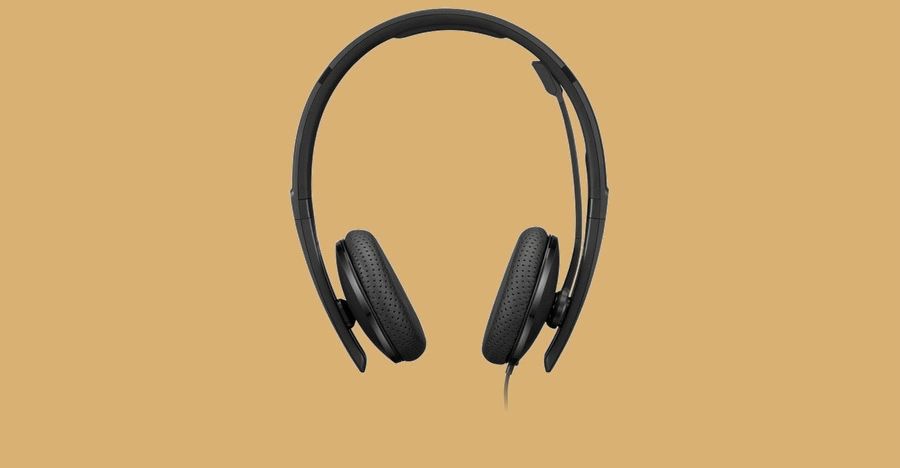
- Connects through USB-C and the included USB-A adapter
- Uses 32 mm drivers with a 20 Hz to 20 kHz speaker range
- Captures calls through a unidirectional 100 Hz to 8 kHz microphone
- Protects users through EPOS ActiveGard and an exposure limiter
- Offers separate Microsoft Teams and Zoom-certified configurations
- Fixed cable with no wireless roaming
- Complete absence of listener-side ANC
- Heavier 140 g build than basic mono wired headsets
- Variant-specific certification that requires careful purchasing
The Lenovo Wired VoIP Headset earns the Best for Unified Communications award because it offers separate Microsoft Teams and Zoom-certified versions, broad platform support, and USB-C connectivity with an included USB-A adapter. Lenovo uses this official product name instead of the supplied reversed wording, “Lenovo VoIP Headset Wired.”
Its 32 mm drivers cover 20 Hz to 20 kHz, while the unidirectional microphone focuses on 100 Hz to 8 kHz. The full-range speaker specification supports calls and media, but it cannot establish exact bass quantity, vocal warmth, treble smoothness, or soundstage size. Its 140 g frame uses large leatherette on-ear cushions that spread pressure but can retain heat during long call blocks.
The unidirectional microphone rejects more off-axis sound than an omnidirectional capsule, while the lack of listener-side ANC leaves incoming office noise audible. ActiveGard and the workplace exposure limiter address sudden peaks and sustained output. The fixed cable prevents roaming but avoids battery depletion and pairing interruptions.
View on Amazon: Lenovo Wired VoIP Headset
10. Lenovo Wireless VoIP Headset
Best for Battery Life
- Provides up to 31 hours of talk time and 60 hours of playback
- Connects two Bluetooth devices simultaneously
- Uses 40 mm drivers with a 20 Hz to 20 kHz range
- Includes replaceable memory-foam earcups
- Supports Microsoft Teams Open Office through its USB-A receiver
- Complete absence of listener-side ANC
- USB-A receiver with no included USB-C receiver option
- Leatherette contact surfaces that can retain heat
- Battery performance that varies with volume and use
The Lenovo Wireless VoIP Headset earns the Best for Battery Life award because its 31-hour talk rating exceeds every other wireless model in this list, while its 60-hour playback rating supports several days of mixed use. Microsoft Teams Open Office certification, multipoint Bluetooth, and replaceable cushions make that endurance practical for call-center work.
Its 40 mm stereo drivers span 20 Hz to 20 kHz, but Lenovo does not publish a response graph that would establish sub-bass impact, vocal warmth, treble smoothness, or instrument spacing. The headset weighs about 140 g and uses adaptive headband geometry with replaceable memory-foam earcups. Its leatherette pads add passive damping but retain more heat than open foam or fabric.
ENC filters the outbound microphone signal, while the lack of listener-side ANC leaves ventilation and nearby speech audible to the wearer. Bluetooth 5.3 stores eight paired devices, maintains two active connections, and works with a supplied USB-A receiver for computer calls. A full charge takes about two hours, and a five-minute charge provides up to two hours of playback.
View on Amazon: Lenovo Wireless VoIP Headset
What to Look for in Call Center Headsets
Evaluate Call Clarity
Prioritize a directional or beamforming microphone with a published communications bandwidth and credible platform certification. A good microphone should keep speech intelligible without transmitting every nearby conversation, keyboard strike, or ventilation fan.
Match Connectivity
Choose wired USB for fixed desks and predictable deployment, Bluetooth for phones and flexible work, or DECT for longer range and dense call environments. Check the exact connector and certification because USB-A, USB-C, Microsoft Teams, and general UC variants can carry different controls.
Protect Hearing
Look for peak limiting, anti-startle processing, and daily exposure management rather than relying only on a volume slider. NIOSH’s 85 dBA recommendation makes controlled output particularly important for agents who keep a headset on throughout an eight-hour shift.
Assess Wearing Comfort
Compare total weight, clamp distribution, pad material, earcup depth, and whether the cushions sit on or around the ears. Fabric and foam usually vent more heat, while leatherette often improves passive isolation but can feel warmer.
Compare Noise Isolation
Separate listener-side ANC from microphone noise reduction because they solve different problems. ANC helps the agent focus on low-frequency hum, while a directional microphone reduces the noise that reaches the caller. HPR’s Bose QuietComfort Earbuds II review shows how seal quality also changes isolation.
Plan Power and Range
Match rated talk time to the longest shift and leave room for battery aging, meetings, and overtime. Treat wireless range as a best-case open-space figure because walls, radio congestion, and adapter placement reduce practical distance.
Frequently Asked Questions
What Type of Headset Works Best in a Call Center?
A stereo headset with a directional boom microphone works well for agents who need focus in a busy room. Mono models suit supervisors and mobile staff who must remain aware of nearby people, while certified open-office headsets offer stronger evidence for microphone performance around competing voices.
Are Wired Headsets Better Than Wireless Headsets for Calls?
Wired headsets provide predictable power, low deployment complexity, and no pairing interruptions. Wireless models add mobility and phone connectivity, but teams must manage charging, radio range, adapters, and battery replacement.
Does a Call Center Headset Need Active Noise Cancelation?
ANC helps agents concentrate by reducing steady low-frequency noise, but it does not guarantee a clear outbound microphone. Teams should evaluate listener isolation and microphone noise rejection separately, then decide whether the working environment justifies the added cost.
Should Agents Choose Mono or Stereo Headsets?
Stereo headsets improve focus by covering both ears and centering call audio, while mono headsets preserve awareness of coworkers and room announcements. Comfort and workflow matter more than the number of earpieces alone.
What Should I Do if a Headset Sounds Muffled?
Check the selected input and output device, call profile, cable or wireless connection, pad placement, and microphone position before replacing the headset. If moisture affects the speaker, HPR’s Fix My Headphones tool may help clear trapped water, but crackling, physical damage, or recurring dropouts require deeper diagnosis.
Final Verdict
The Jabra Engage 55 SE offers the strongest overall balance for call-intensive desks because DECT range, a qualified open-office microphone, hearing safeguards, and 13-hour talk time directly serve contact-center work. The Jabra Evolve3 85 costs more but adds premium ANC, broader media support, multipoint Bluetooth, and an over-ear design for hybrid professionals.
Budget-focused teams should choose the Logitech H570e USB Headset for dependable wired deployment, while mobile users gain more freedom from the Yealink BH71 or Poly Voyager 4320 UC. The ThinkPad 8550 fits noisy open offices, and the Lenovo Wireless VoIP Headset leads this group when battery endurance matters most.
No single headset fits every agent. Match the exact variant to the desk connection, approved calling platform, room noise, shift length, and wearing preference before a fleet purchase.