
A powerful home theater can reach serious listening levels, but louder does not automatically mean clearer or more immersive. For perspective, the National Institute for Occupational Safety and Health (NIOSH) sets an occupational limit of 85 A-weighted decibels (dBA) over eight hours, then recommends halving exposure time for every 3-decibel increase. That workplace guidance is not a home-listening target, but it shows why clean dialogue, controlled bass, and usable volume management matter as much as maximum output.
Dolby Atmos soundbars now range from compact virtualizers to 11.1.4 systems with wireless rear speakers and a dedicated subwoofer. This guide covers small apartments, large living rooms, movie-first systems, music streaming, gaming, and premium all-in-one designs, while also explaining when a traditional setup may suit you better in our soundbar versus speakers comparison.
We evaluated these 11 products from current manufacturer specifications, manuals, connection standards, supplied components, room-calibration features, and supported formats. The article does not claim firsthand Headphones Pro Review (HPR) testing where no testing notes were supplied, so performance judgments stay tied to documented hardware and supportable acoustic principles.
Quick Overview for Dolby Atmos Soundbars
| Best Soundbar Overall | Sonos Arc Ultra |
| Best Soundbar for Audiophiles | KEF XIO Soundbar |
| Best Soundbar for Home Theater | Samsung HW-Q990H |
| Best Soundbar for Gaming | Sony BRAVIA Theater Bar 9 |
| Best Surround Soundbar System | JBL Bar 1300XMK2 |
| Best Soundbar for Large Rooms | Yamaha TRUE X SURROUND 90A |
| Best Compact Soundbar | Sonos Beam (Gen 2) |
| Best Premium All-in-One Soundbar | Sennheiser AMBEO Soundbar Max |
| Best Soundbar for Music Streaming | Bluesound PULSE CINEMA |
| Best Budget Atmos Soundbar System | Hisense AX5140Q |
| Best New and Innovative Soundbar | ULTIMEA Skywave X100 9.1.6 Soundbar |
In-Depth Look: Dolby Atmos Soundbars
1. Sonos Arc Ultra
Best Soundbar Overall
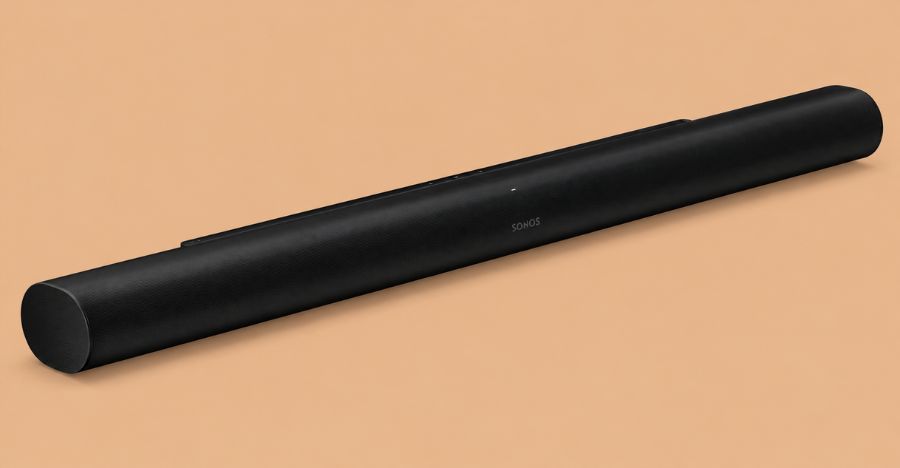
- Delivers a 9.1.4 spatial presentation through 14 Sonos-engineered drivers
- Clarifies voices with four levels of Speech Enhancement
- Tunes output to room acoustics through Trueplay Equalization (EQ)
- Expands wirelessly with Sonos subwoofers and rear speakers
- Supports Dolby TrueHD Atmos through Enhanced Audio Return Channel (eARC)
- Requires separate purchases for a physical subwoofer and rear channels
- Omits dedicated High-Definition Multimedia Interface (HDMI) passthrough inputs
- Limits Digital Theater Systems support to DTS Digital Surround rather than DTS:X
The Sonos Arc Ultra earns the Best Soundbar Overall award because it combines a manageable single-bar design with 9.1.4 processing, 14 drivers, advanced dialogue tools, and a mature wireless ecosystem. It covers movies, television (TV), and music without forcing buyers into a multi-box system on day one.
Fifteen Class-D amplifiers drive nine angled silk-dome tweeters, six midwoofers, and Sonos’s flat Sound Motion woofer architecture. Two up-firing tweeters supply physical height information, while the angled front array broadens lateral effects beyond the cabinet. This layout should keep voices anchored near the screen while spreading ambience and effects across a wider front stage.
At 46.38 inches wide, Arc Ultra fits best beneath a 55-inch or larger TV with open space above and beside the bar. Trueplay analyzes room behavior, Speech Enhancement raises vocal intelligibility when ambient noise masks dialogue, and Night Sound reduces sharp level jumps. Buyers who want more low-frequency headroom can compare expansion options in our guide to a soundbar with a subwoofer.
The single HDMI eARC connection accepts Dolby Digital Plus Atmos, Dolby TrueHD Atmos, multichannel Pulse-Code Modulation (PCM), and standard Digital Theater Systems (DTS) Digital Surround. Wi-Fi 6, Bluetooth 5.3, AirPlay 2, voice control, and app-based bass and treble adjustments make the bar flexible, but source devices must connect through the TV because Arc Ultra provides no HDMI input.
View on Amazon: Sonos Arc Ultra
2. KEF XIO Soundbar
Best Soundbar for Audiophiles
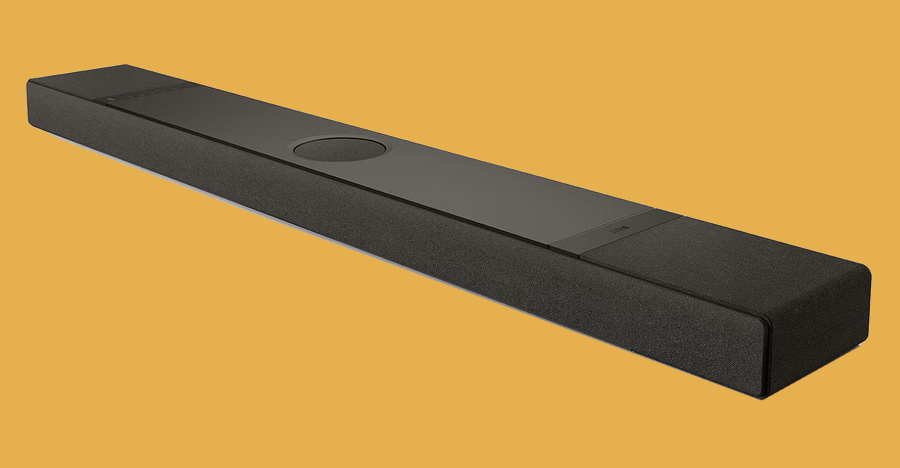
- Drives 12 speaker units with 820 watts of instantaneous rated power
- Reproduces 5.1.2 sound through Uni-Q MX and P185 low-frequency drivers
- Streams files at up to 24-bit and 384 kHz through the network
- Supports Dolby Atmos, DTS:X, and Sony 360 Reality Audio
- Adapts output to nearby surfaces through Intelligent Placement Technology
- Commands a premium price for a single-bar system
- Requires an added subwoofer for the deepest cinematic effects
- Omits a separate HDMI passthrough input for consoles and disc players
The KEF XIO Soundbar earns the Best Soundbar for Audiophiles award because it treats music reproduction as a primary job rather than a secondary feature. Its 12-driver, 12-amplifier platform supports high-resolution streaming, broad format compatibility, and a specified 34 Hz to 20 kHz range.
Six 2-inch Uni-Q MX coaxial units, two additional full-range drivers, and four P185 low-frequency drivers divide vocal, treble, and bass duties across the 47.6-inch cabinet. Coaxial high-frequency and midrange radiation can support more consistent imaging across several seats, while the four rectangular bass drivers provide greater cone area than a typical slim bar. The 5.1.2 layout still relies on room reflections for part of its height and surround impression.
The XIO weighs 23.1 pounds and needs a rigid stand or properly anchored wall mount. Intelligent Placement Technology detects nearby surfaces and adjusts EQ, which helps when a wall, shelf, or TV changes boundary reinforcement. Its rated 102 dB at one meter suggests useful headroom, but buyers should treat that figure as KEF’s specification rather than an HPR measurement.
HDMI eARC handles up to 24-bit and 192 kHz audio, while network playback reaches up to 24-bit and 384 kHz. AirPlay, Google Cast, Bluetooth 5.3, Spotify Connect, TIDAL Connect, Qobuz, and other services make it a strong music hub. A wired Radio Corporation of America (RCA) subwoofer output and optional KEF wireless adapter provide two bass-expansion paths. Music-first shoppers can also compare the XIO’s all-in-one approach with our guide to the best speakers for vinyl.
View on Amazon: KEF XIO Soundbar
3. Samsung HW-Q990H
Best Soundbar for Home Theater
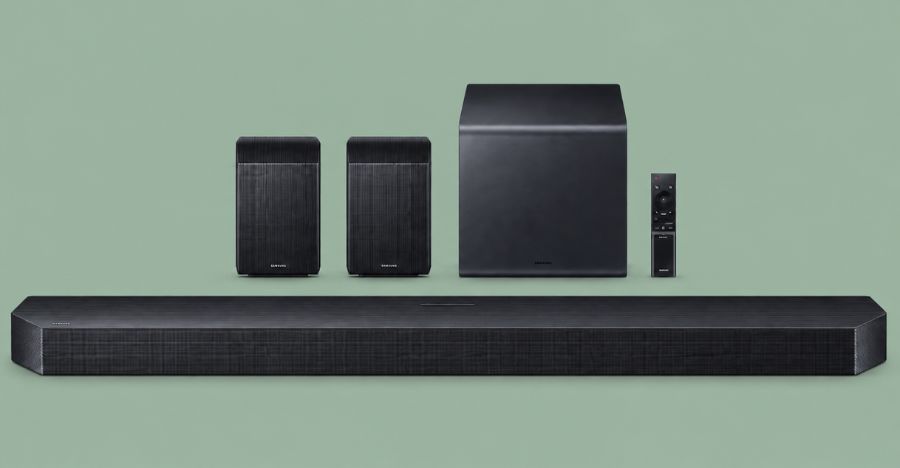
- Delivers a complete 11.1.4 layout with a 7.0.2 bar and 4.0.2 rear speakers
- Includes a compact subwoofer with dual 8-inch active drivers
- Adapts frequency balance through SpaceFit Sound Pro
- Lifts dialogue toward the screen through Sound Elevation
- Synchronizes compatible Samsung TV speakers through Q-Symphony
- Demands floor space and power access for the subwoofer and rear speakers
- Reserves Q-Symphony integration for compatible Samsung televisions
- Carries flagship pricing despite its compact-subwoofer redesign
The Samsung HW-Q990H earns the Best Soundbar for Home Theater award because it supplies the front stage, four height channels, discrete rear coverage, and dedicated bass hardware in one coordinated 11.1.4 package. Buyers do not need to add speakers later to obtain rear and overhead channels.
Samsung divides the system into a 7.0.2 main bar, 4.0.2 rear speakers, and a subwoofer with dual 8-inch active drivers. That allocation gives Atmos mixes physical channels behind and above the listener instead of asking a single cabinet to virtualize the entire room. The dual-driver subwoofer should add impact below the bar’s working range while using less floor area than a conventional large enclosure.
SpaceFit Sound Pro uses a built-in microphone to analyze the room and adjust the system. Adaptive Sound changes processing for different content, Sound Elevation moves dialogue toward the screen, and Auto Volume reduces disruptive jumps between programs and sources. These functions target common room and ambient-noise problems without inventing measured performance claims.
Wireless Dolby Atmos can reduce cabling with compatible Samsung TVs, while Q-Symphony coordinates the soundbar with supported TV speakers. Buyers considering a receiver-free package can compare this approach with the options in our multi-channel home theater guide. The Q990H remains a better fit for medium and large rooms than bedrooms because the rear units and subwoofer need deliberate placement.
View on Amazon: Samsung HW-Q990H
4. Sony BRAVIA Theater Bar 9
Best Soundbar for Gaming
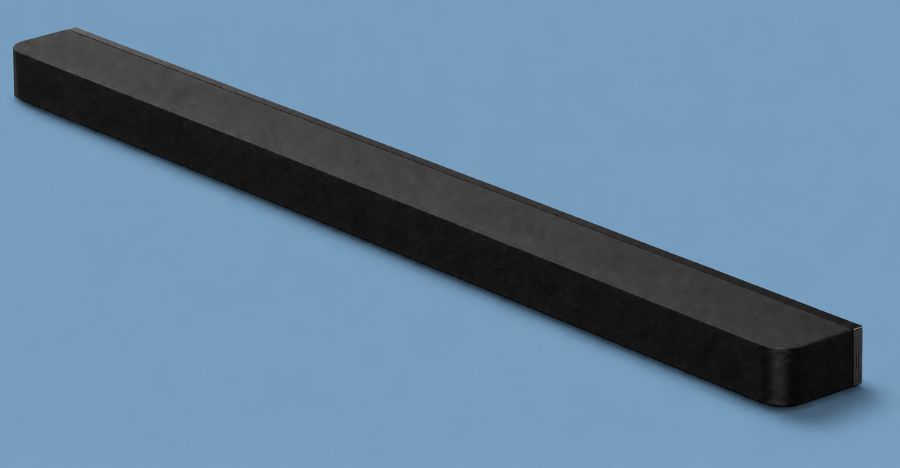
- Passes compatible 4K at 120 frames per second and Variable Refresh Rate (VRR) video
- Uses a 7.0.2 structure with 13 physical speaker units
- Decodes Dolby Atmos, DTS:X, and IMAX Enhanced soundtracks
- Calibrates spatial processing through Sound Field Optimization
- Expands with optional Sony subwoofers and wireless rear speakers
- Requires optional speakers for physical rear channels and deeper bass
- Spans 51.25 inches and can overwhelm narrow TV furniture
- Reserves its closest TV integration for compatible Sony BRAVIA models
The Sony BRAVIA Theater Bar 9 earns the Best Soundbar for Gaming award because it combines immersive format support with a gaming-focused HDMI path for compatible 4K120 and VRR signals. Its single input also gives one console or source device a direct route through the bar before audio returns through eARC.
The 7.0.2 system uses 13 speaker units, including a two-way front and center design, side speakers, beam tweeters, up-firing units, four woofers, and passive radiators. This hardware provides physical front width and height cues, while 360 Spatial Sound Mapping generates phantom positions around the room. The center-focused architecture should improve dialogue localization, but a separate subwoofer will add more authority to low-frequency effects.
At 51.25 inches wide but only 2.625 inches high, the Bar 9 suits wide televisions and low-profile stands. Sound Field Optimization accounts for room geometry and listening position through the BRAVIA Connect app, which matters when one side wall sits closer than the other. Voice Mode and Night Mode can help preserve speech at modest levels or against household noise.
The Bar 9 accepts Dolby TrueHD, DTS High-Definition (DTS-HD) Master Audio, DTS:X, IMAX Enhanced, and up to 192 kHz, 24-bit Linear Pulse-Code Modulation (LPCM) through eARC. Buyers with several consoles may still need an HDMI switch, TV-based routing, or one of the best HDMI audio extractors because the bar provides only one HDMI input.
View on Amazon: Sony BRAVIA Theater Bar 9
5. JBL Bar 1300XMK2
Best Surround Soundbar System
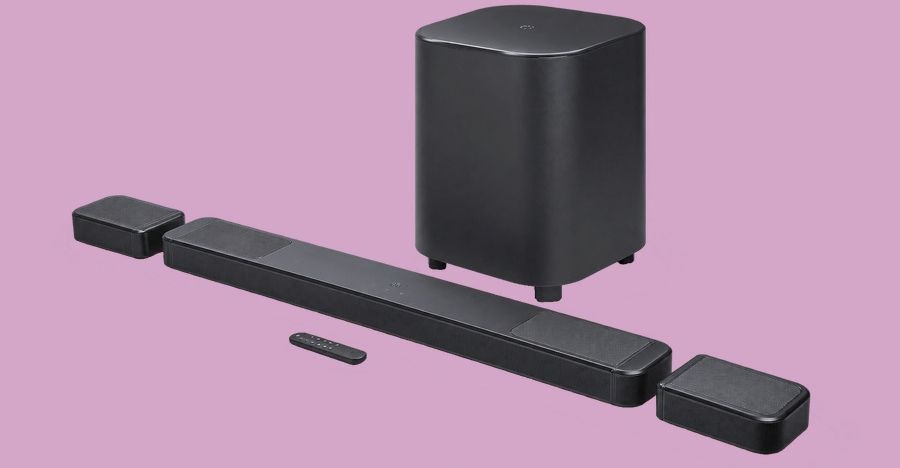
- Delivers an 11.1.4 layout with six up-firing speaker units
- Converts two detachable rear modules into battery-powered surround speakers
- Supplies up to 10 hours of rated rear-speaker playback per charge
- Adds low-frequency scale through a 12-inch wireless subwoofer
- Supports Dolby Atmos, DTS:X, room calibration, and 4K Dolby Vision passthrough
- Requires substantial space for the bar, subwoofer, and deployed rear speakers
- Requires regular docking or charging of the detachable surround modules
- Reports 1,570 watts as maximum output rather than a continuous-power figure
The JBL Bar 1300XMK2 earns the Best Surround Soundbar System award because its detachable modules provide physical rear and height channels without permanent speaker wiring. The modules dock onto the bar for charging, then move behind the seating area when a soundtrack benefits from true rear placement.
The 11.1.4 architecture combines eight racetrack drivers, seven tweeters, and four up-firing units in the main bar with front and up-firing drivers in each surround. A 12-inch wireless subwoofer handles the lowest effects. This distribution should create more definite front-to-back motion than a single-bar virtualizer, while MultiBeam 3.0 uses reflected energy to widen the stage.
PureVoice 2.0 adjusts dialogue emphasis according to content and volume, and the automated calibration system accounts for wall and furniture reflections. Night Listening can mute the bar and subwoofer while routing sound to the detachable speakers placed near the listener. That mode offers a practical way to maintain intelligibility without filling the room with late-night bass.
HDMI eARC carries lossless Atmos, and the single HDMI input supports 4K Dolby Vision passthrough. AirPlay, Google Cast, Spotify Connect, TIDAL Connect, and Roon Ready broaden music access. Buyers comparing full packages can review our broader list of the best surround sound systems.
View on Amazon: JBL Bar 1300XMK2
6. Yamaha TRUE X SURROUND 90A
Best Soundbar for Large Rooms
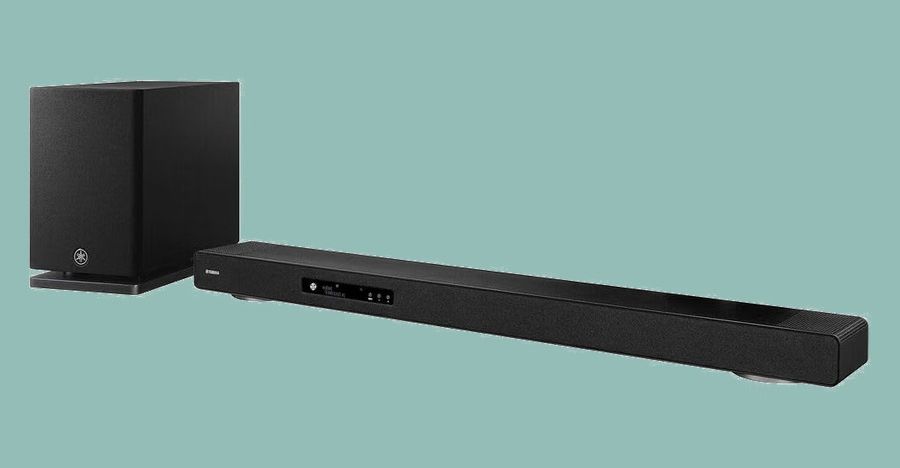
- Projects height information through 12 Digital Signal Processing (DSP) controlled beam speakers
- Includes a wireless subwoofer and two portable wireless rear speakers
- Decodes Dolby Atmos, DTS:X, and AURO-3D soundtracks
- Adapts spatial processing scene by scene through SURROUND:AI
- Streams through MusicCast, AirPlay 2, Spotify Connect, TIDAL Connect, and Qobuz
- Requires a wide stand and separate positions for three wireless components
- Limits passthrough to 4K rather than advertising 4K120 gaming support
- Provides only one HDMI input and no analog audio input
The Yamaha TRUE X SURROUND 90A earns the Best Soundbar for Large Rooms award because its 46.5-inch metal bar, 12 height-beam drivers, wireless subwoofer, and two rear speakers distribute sound across several physical locations. That architecture suits broad seating areas better than a compact bar that relies entirely on front-wall reflections.
Yamaha pairs eye-shaped full-range front and center drivers with dedicated tweeters, then assigns six DSP-controlled beam speakers to each side for height effects. A 6.75-inch wireless subwoofer handles bass, while each rear speaker uses a 2.25-inch full-range unit and passive radiators. The result is a hardware layout built for scale, separation, and overhead projection, though final results still depend on ceiling height and room symmetry.
SURROUND:AI analyzes scenes and adjusts spatial processing in real time, while Clear Voice and Bass Extension address dialogue and low-frequency balance. The rear speakers can leave their charging cradles for flexible placement and switch into portable Solo mode. Each rear is small, but the full package still needs a thoughtful layout and nearby charging access.
The system provides one HDMI input, one eARC output, optical audio, 4K passthrough, Wi-Fi, and Bluetooth 4.2. Dolby Atmos, DTS:X, and AURO-3D cover major immersive formats, while MusicCast handles app control and multi-room playback. Projector owners should confirm outputs and lip-sync behavior using our projector speaker connection guide before installation.
View on Amazon: Yamaha TRUE X SURROUND 90A
7. Sonos Beam (Gen 2)
Best Compact Soundbar
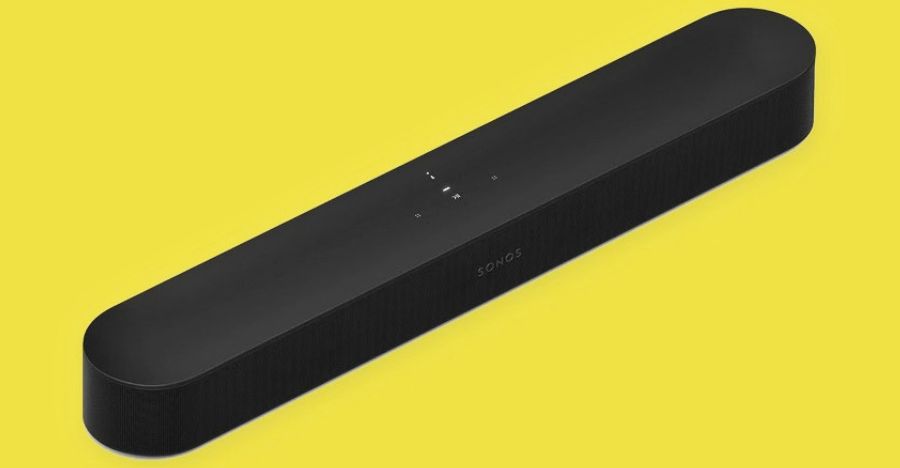
- Fits narrow furniture with a 25.63-inch cabinet
- Prioritizes dialogue through a dedicated center tweeter and Speech Enhancement
- Supports Dolby TrueHD Atmos and multichannel PCM through eARC
- Tunes frequency balance through Trueplay
- Expands wirelessly with Sonos rear speakers and subwoofers
- Virtualizes Atmos height without dedicated up-firing drivers
- Requires extra speakers for physical rear channels and deep bass
- Omits Bluetooth streaming and HDMI passthrough inputs
The Sonos Beam (Gen 2) earns the Best Compact Soundbar award because it fits a five-amplifier acoustic system, Dolby Atmos decoding, room tuning, and strong dialogue controls into a 25.63-inch body. It offers a meaningful TV-audio upgrade where a full-width flagship bar would dominate the furniture.
Four elliptical midwoofers, one center tweeter, and three passive radiators concentrate on the front stage and vocal range. Digital processing virtualizes Atmos height, so overhead effects will depend more heavily on room geometry than they do with physical up-firing speakers. The center tweeter and Speech Enhancement should give news, dramas, and podcasts clearer focus than basic two-channel TV speakers.
The Beam weighs 6.35 pounds and needs only power plus one HDMI cable. Trueplay analyzes room acoustics through a supported iOS device, while Night Sound reduces large level jumps that can mask quieter speech or disturb adjacent rooms. Apartment buyers can compare other simple options in our wireless TV speaker guide and our overview of 3.1 sound systems.
HDMI eARC supports Dolby Digital Plus Atmos, Dolby TrueHD Atmos, multichannel PCM, and standard DTS Digital Surround. AirPlay 2, Wi-Fi streaming, voice control, and the Sonos app cover daily operation, but the Beam lacks Bluetooth audio and depends on the TV for source switching.
View on Amazon: Sonos Beam (Gen 2)
8. Sennheiser AMBEO Soundbar Max
Best Premium All-in-One Soundbar
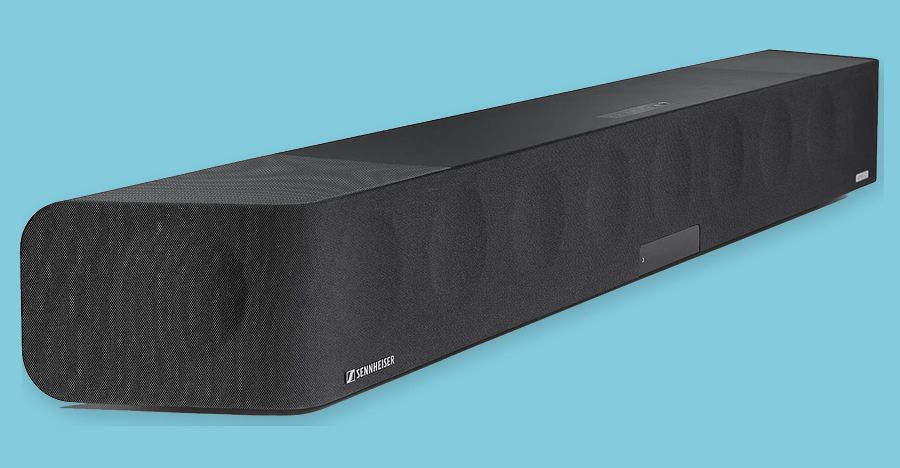
- Produces a virtual 5.1.4 field through 13 independently amplified drivers
- Extends to a manufacturer-rated 30 Hz without an external subwoofer
- Calibrates output with an included measurement microphone
- Supports Dolby Atmos, DTS:X, and stereo upmixing
- Connects through eARC, optical, analog RCA, Wi-Fi, and streaming services
- Weighs about 40.8 pounds and needs substantial furniture support
- Stands about 5.3 inches high and may block a low-mounted TV
- Limits video passthrough to 4K60 rather than current 4K120 gaming signals
The Sennheiser AMBEO Soundbar Max earns the Best Premium All-in-One Soundbar award because its 13-driver cabinet combines a virtual 5.1.4 presentation with unusually deep specified bass. Buyers can obtain immersive decoding and room calibration without placing a separate subwoofer or rear speakers.
Six 4-inch long-throw woofers, five 1-inch aluminum tweeters, and two 3.5-inch top-firing full-range drivers divide the 30 Hz to 20 kHz specified range. The front array supplies midrange density and bass cone area, while the top drivers provide ceiling-reflected height information. AMBEO processing virtualizes side and rear positions, so reflective walls and careful calibration matter more than they do with discrete rear speakers.
The Max measures roughly 49.6 inches wide, 5.3 inches high, and 6.7 inches deep. Its included measurement microphone maps the room, which helps the processor manage unequal wall distances and bass reinforcement. The cabinet’s size and weight demand more planning than a typical all-in-one bar, and its height can cover the bottom of some screens.
HDMI eARC, optical Sony/Philips Digital Interface (S/PDIF), analog RCA, a subwoofer pre-out, AirPlay 2, Chromecast, Spotify Connect, and TIDAL Connect provide broad source access. The 4K60 passthrough ceiling makes direct console routing less attractive for 120 Hz gaming. Readers with older televisions can compare the trade-offs in our optical audio cable guide and digital coaxial cable guide.
View on Amazon: Sennheiser AMBEO Soundbar Max
9. Bluesound PULSE CINEMA
Best Soundbar for Music Streaming
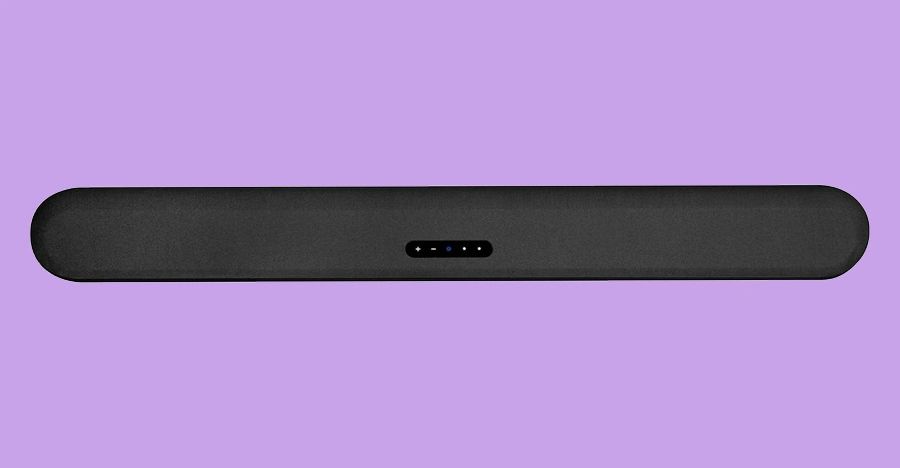
- Drives a 3.2.2 layout with 16 drivers and 500 watts of rated system power
- Streams files at up to 24-bit and 192 kHz through BluOS
- Supports Direct Stream Digital (DSD) 256 and Master Quality Authenticated (MQA) files
- Integrates AirPlay 2, Spotify Connect, TIDAL Connect, Qobuz Connect, and Roon Ready
- Expands with wired or wireless subwoofers and compatible Bluesound surrounds
- Requires optional speakers for physical rear surround and stronger sub-bass
- Omits DTS:X from the listed multichannel format support
- Spans 47.12 inches despite its all-in-one configuration
The Bluesound PULSE CINEMA earns the Best Soundbar for Music Streaming award because it combines a 500-watt, 16-driver soundbar with the BluOS high-resolution and multi-room platform. Its support for 24-bit, 192 kHz playback, DSD256, MQA, and several lossless-capable services goes well beyond basic Bluetooth streaming.
Five tweeters, five midrange drivers, two 4-inch woofers, and four passive radiators form a 3.2.2 layout. Dedicated center and up-firing channels give dialogue and height information distinct hardware paths, while the dual woofers and passive radiators reinforce bass without a separate enclosure. The bar supports Dolby TrueHD Atmos but does not list DTS:X, so disc collectors should check their library before buying.
At 47.12 inches wide and 14.75 pounds, PULSE CINEMA pairs well with larger TVs. Automatic orientation sensing adjusts processing for tabletop or wall placement, and the included wall bracket simplifies the second option. Movie, Music, and Late Night modes change priorities for spatial impact, tonal balance, or reduced disturbance.
HDMI eARC, optical, analog RCA, gigabit Ethernet, dual-band Wi-Fi, Bluetooth 5.2 with aptX Adaptive, and two-way Bluetooth cover modern and legacy sources. The RCA and wireless subwoofer outputs allow bass expansion, while compatible PULSE M or PULSE FLEX speakers can add rear channels through BluOS.
View on Amazon: Bluesound PULSE CINEMA
10. Hisense AX5140Q
Best Budget Atmos Soundbar System
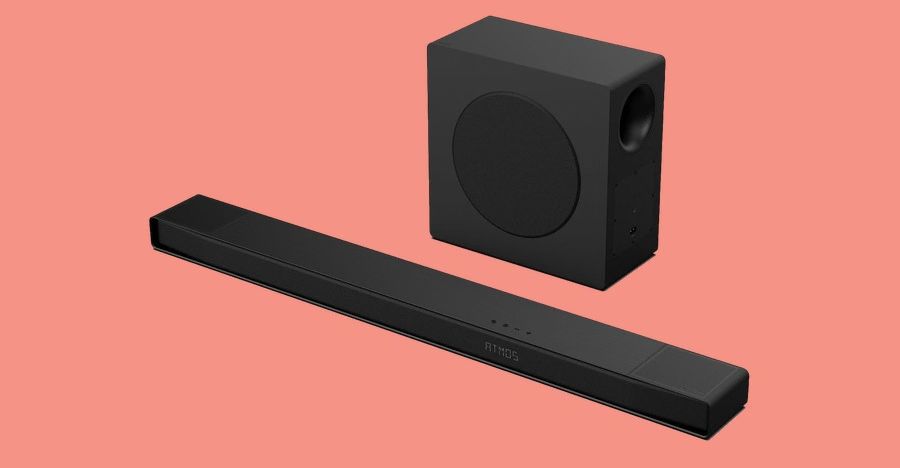
- Delivers a 5.1.4 package with four up-firing speakers
- Includes a wireless subwoofer and wireless rear surround speakers
- Decodes Dolby Atmos, DTS:X, DTS-HD Master Audio, and multichannel PCM
- Supplies a manufacturer-rated 600 watts of total output
- Adds Game Pro, Artificial Intelligence (AI) EQ, and room-fitting features
- Reserves Hi-Concerto and some tuning features for compatible Hisense TVs
- Uses HDMI 2.0 rather than a clearly specified HDMI 2.1 gaming path
- Faces fluctuating U.S. availability despite current official product support
The Hisense AX5140Q earns the Best Budget Atmos Soundbar System award because it includes a 5.1.4 bar, wireless subwoofer, and rear speakers at a lower tier than most complete Atmos packages. Four up-firing speakers provide physical height channels, including two in the rear surrounds.
The multi-box layout gives movie effects real positions behind the listener and separates bass from the main bar. Hisense specifies a 40 Hz to 20 kHz range for the bar and 600 watts of total output for the system, including 200 watts for the bar and 280 watts for the subwoofer. Those figures describe the manufacturer’s rating, not an HPR bench measurement.
Room Fitting Tuning, AI EQ, Game Pro, and EzPlay 3.0 target different content and room conditions. Hi-Concerto can combine compatible Hisense TV speakers with the soundbar, but buyers using another TV brand should evaluate the system on its standard inputs and sound modes. Wireless rear and subwoofer links reduce signal cabling, although each powered component still needs electricity.
The system supports Dolby Atmos, DTS:X, DTS-HD Master Audio, optical audio, Bluetooth 5.3, and HDMI passthrough. Buyers who prioritize included bass hardware can compare it with other packages in our soundbar and subwoofer guide, while remembering that official U.S. stock can change.
View on Amazon: Hisense AX5140Q
11. ULTIMEA Skywave X100 9.1.6 Soundbar
Best New and Innovative Soundbar
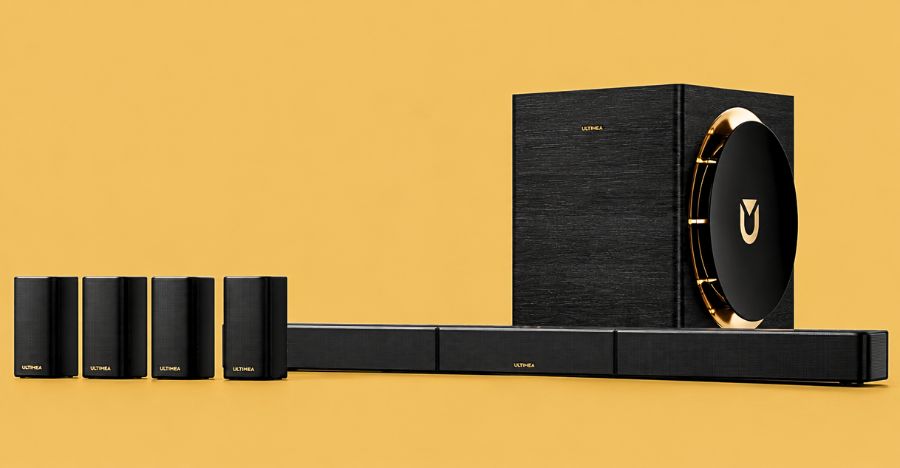
- Distributes 19 speakers across a 9.1.6 layout
- Includes four wireless surround speakers and a 10-inch subwoofer
- Passes 8K60 and 4K120 High Dynamic Range (HDR) video through HDMI 2.1
- Tunes channels independently through app controls and 121 EQ presets
- Supports Dolby Atmos, DTS:X, and THX-tuned system voicing
- Requires power access for four surrounds, the bar, and the subwoofer
- Uses peak-power and minus-10 dB bass specifications that need careful comparison
- Carries less long-term field history than established flagship systems
The ULTIMEA Skywave X100 9.1.6 Soundbar earns the Best New and Innovative Soundbar award because it combines 19 speakers, four wireless surrounds, six height channels, HDMI 2.1 passthrough, and app-level channel control in a newly launched package. Its specification set targets buyers who want high channel density without an Audio/Video receiver.
The main bar uses multiple 2.25-inch drivers and two 1-inch tweeters, while four surround cabinets add eight more 2.25-inch drivers and the 10-inch subwoofer handles bass. ULTIMEA specifies a 20 Hz to 20 kHz range, bass at 20 Hz and minus 10 dB, and 1,500 watts peak. Those numbers indicate claimed extension and short-term output, but they should not be compared directly with continuous-power ratings from other brands.
Independent channel-level controls help balance four surrounds across asymmetric rooms and off-center seating. The app adds a 10-band EQ and 121 preset matrices, while NEURACORE processing expands multichannel material. Six powered speaker locations give the system broad coverage, but they also create the most complex placement and outlet plan in this list.
HDMI 2.1 passthrough supports 8K60 and 4K120 HDR video, while eARC, optical, Universal Serial Bus (USB), and Bluetooth handle other sources. Dolby Atmos, DTS:X, and THX-tuned voicing strengthen the format list. Early adopters should still judge firmware support, service availability, and long-term reliability separately from the ambitious specifications.
View on Amazon: ULTIMEA Skywave X100 9.1.6 Soundbar
What to Look for in Dolby Atmos Soundbars
Match the Channel Layout to the Room. A 5.1.2 label describes five bed-layer channels, one bass channel, and two height channels, while 11.1.4 adds more side, rear, and height positions. Physical rear and up-firing speakers usually create more stable spatial cues than full virtualization, but they need reflective ceilings, suitable wall distances, and thoughtful placement.
Match the Bass Hardware to the Space. A dedicated subwoofer usually reaches lower and plays more cleanly than small bar-mounted woofers, especially during effects-heavy movies. Apartments may benefit from an all-in-one design, Night Mode, or a compact sub with adjustable level to reduce structure-borne bass.
Match the Connections to the Sources. HDMI eARC can carry lossless Dolby TrueHD Atmos and multichannel PCM from a compatible TV, while standard Audio Return Channel (ARC) and optical connections offer less bandwidth. Gamers should confirm 4K120, VRR, Auto Low Latency Mode, and HDR passthrough instead of assuming every HDMI port supports them.
Match the Calibration to the Room. Microphone-based room correction can balance channels, timing, and bass after placement changes. Simpler placement detection or preset modes still help, but they cannot fully correct poor speaker positions, blocked up-firing drivers, or highly absorbent ceilings.
Match the Format Support to the Library. Streaming services commonly deliver Atmos through Dolby Digital Plus, while Ultra HD Blu-ray discs can use Dolby TrueHD Atmos. Disc collectors should also check DTS:X and DTS-HD Master Audio support because some soundbars accept Dolby formats but omit advanced DTS decoding.
Match the Expansion Path to the Budget. A lower-priced standalone bar may become expensive after adding a subwoofer and two rear speakers. Compare the complete system cost, required outlets, furniture space, app dependence, and replacement options before choosing between an expandable bar and a package that includes every speaker.
Frequently Asked Questions
Do Up-Firing Speakers Guarantee Good Dolby Atmos?
No. Up-firing speakers need a reasonably flat, reflective ceiling and enough clearance above the bar. Vaulted, absorbent, or unusually high ceilings can weaken reflected height cues, so physical ceiling speakers or carefully placed surrounds may work better.
Is 5.1.2 Enough for a Small Room?
Yes, a well-positioned 5.1.2 system can create clear front, rear, bass, and height information in a compact room. More channels help cover larger spaces and wider seating areas, but placement and calibration often matter more than the number printed on the box.
Do I Need HDMI eARC for Dolby Atmos?
Not for every Atmos stream. Dolby Digital Plus Atmos can travel through some ARC connections, but eARC provides the bandwidth required for Dolby TrueHD Atmos and high-rate multichannel PCM from compatible sources.
Should I Buy a Soundbar With Rear Speakers?
Choose physical rears when front-to-back movement and stable surround placement matter most. A single bar saves space and reduces wiring, but even advanced virtualization depends more heavily on room reflections and seating position.
What Matters Most for Gaming?
Confirm 4K120, VRR, low-latency video handling, and correct eARC behavior across the TV, console, cables, and soundbar. A product can support Dolby Atmos audio yet still limit video passthrough to 4K60.
Final Verdict
The Sonos Arc Ultra is the strongest overall choice for buyers who want polished everyday operation, clear dialogue tools, useful bass from one cabinet, and a simple path to future expansion. The Samsung HW-Q990H is the more complete home theater purchase because its 11.1.4 package includes the rear speakers and dual-driver subwoofer from the start.
Smaller rooms should start with the Sonos Beam (Gen 2), while value-focused buyers who want physical rears and four height channels should consider the Hisense AX5140Q when stock and pricing make sense. Music-first buyers should choose between the KEF XIO Soundbar’s high-end acoustic hardware and the Bluesound PULSE CINEMA’s deeper streaming and multi-room features.
The Sony BRAVIA Theater Bar 9 fits gaming setups, the Yamaha TRUE X SURROUND 90A fits broad rooms, and the JBL Bar 1300XMK2 fits buyers who value detachable physical surrounds. Choose the Sennheiser AMBEO Soundbar Max when one-box bass and virtualization justify its size, or the ULTIMEA Skywave X100 when its ambitious 9.1.6 layout and newer platform match your appetite for early adoption.