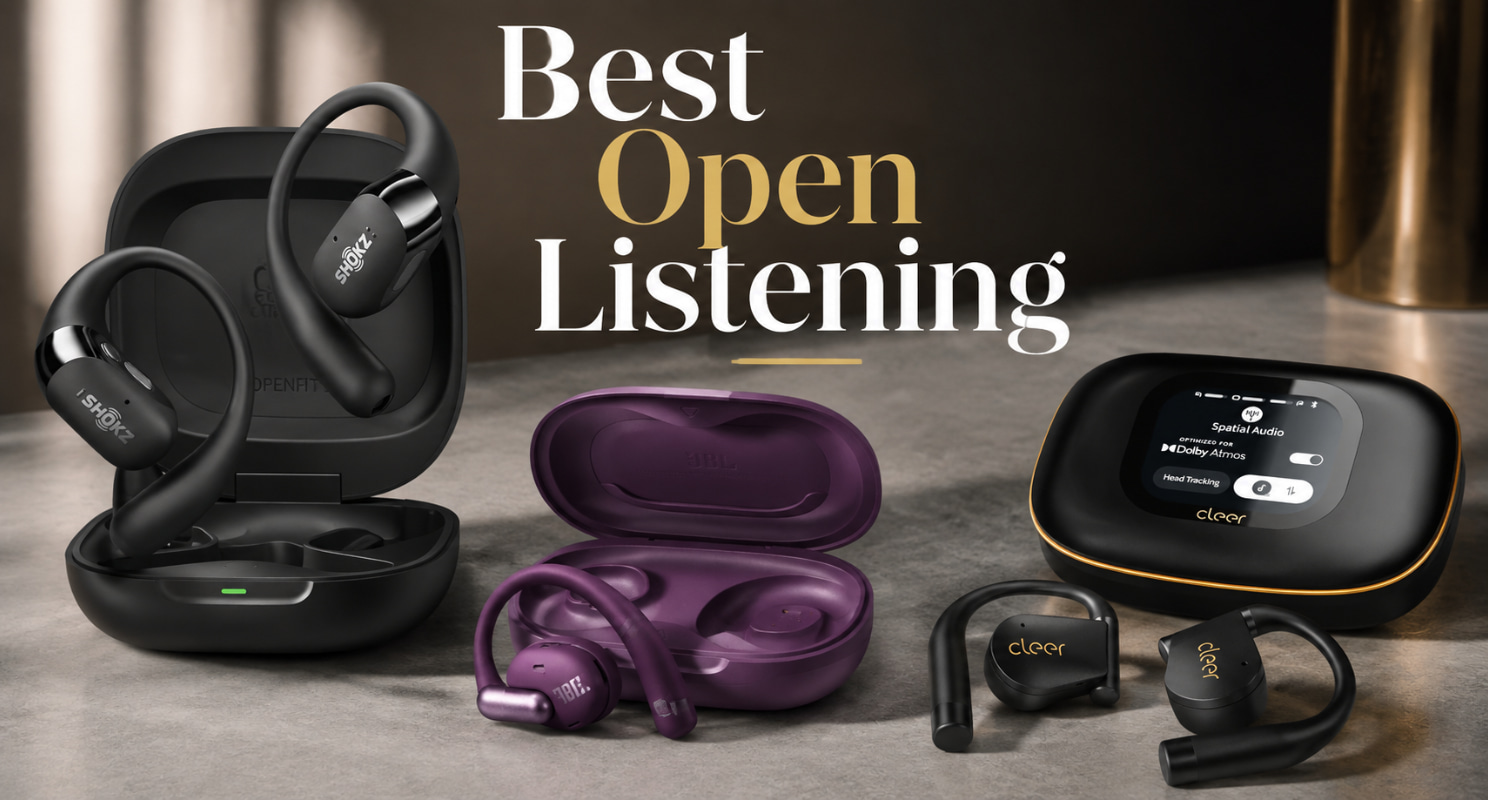
Open-wear stereo earbuds keep the ear canal unobstructed, making them useful when traffic, announcements, coworkers, or family conversations still need attention. That awareness does not remove the need for careful volume control. The World Health Organization’s safe-listening guidance says adults can listen at 80 decibels for up to 40 hours per week, while raising the level to 90 decibels reduces the allowance to four hours.
The strongest open-wear models use directional air conduction, stable ear hooks or clips, and thoughtful Equalization (EQ) to compensate for the bass loss that occurs without a sealed ear tip. Driver position matters as much as driver size because a small change in the distance from the ear can alter bass weight, vocal clarity, and perceived stereo balance. Active Noise Cancelation (ANC), spatial processing, microphone quality, battery life, and app controls further separate a basic awareness earbud from a complete everyday audio product.
This guide covers options for Apple users, workouts, office calls, long listening days, spatial audio, detailed EQ control, and value-focused shopping. Readers who work around traffic or machinery should also compare our guide to the best earbuds for outdoor work before choosing between maximum awareness and stronger isolation. Every evaluation below uses current manufacturer specifications, official support material, and supportable acoustic principles without inventing listening sessions, comfort tests, call samples, or laboratory measurements.
Quick Overview for Open Wear Stereo Earbuds
| Best Open-Wear Earbuds for Apple Users | Apple AirPods 4 |
| Overall Best Open-Wear Stereo Earbuds | Shokz OpenFit Pro |
| Best Open-Wear Earbuds for All-Day Comfort | Shokz OpenFit 2+ |
| Best Value Clip-On Open-Wear Earbuds | Baseus Bowie MC2 Open-Ear True Wireless Earbuds |
| Best Open-Wear Earbuds for Calls | JBL Sense Pro |
| Best Open-Wear Earbuds for Spatial Audio | Cleer ARC 5 Open-Ear Earbuds |
| Best Open-Wear Earbuds for EQ Control | Nothing Ear (open) |
In-Depth Look: Open Wear Stereo Earbuds
1. Apple AirPods 4
Best Open-Wear Earbuds for Apple Users
- Integrates Adaptive EQ, Spatial Audio, and Adaptive Audio across compatible Apple devices
- Reduces steady environmental noise without using silicone ear tips
- Weighs only 4.3 g per earbud and carries an IP54 dust and water rating
- Supports wireless case charging, Voice Isolation, and Conversation Awareness
- Restricted manual EQ control compared with app-based graphic or parametric systems
- Short four-hour earbud rating when ANC remains active
- Universal shell shape that cannot provide the same fit adjustment as interchangeable tips
The Apple AirPods 4 earns the Best Open-Wear Earbuds for Apple Users award because the supplied Amazon link selects the ANC configuration, which connects Adaptive EQ, Adaptive Audio, Transparency mode, Conversation Awareness, and Personalized Spatial Audio through the H2 chip. An iPhone, iPad, Mac, or Apple TV user can move between music, calls, movies, and device switching without managing separate tuning profiles, although non-Apple devices receive a more limited Bluetooth experience.
Apple combines a custom high-excursion driver with an inward-facing microphone that monitors the sound reaching the ear and adjusts low and middle frequencies automatically. The semi-open shell avoids the pressure of a sealed ear tip and weighs only 4.3 g, but its universal contour cannot accommodate every ear equally, so bass response and stability can vary with anatomy. Buyers who prefer a sealed fit and stronger passive attenuation can compare the different design priorities in our Bose QuietComfort Earbuds II review.
The ANC version targets low-frequency sounds such as engines and city traffic, but its vented fit cannot isolate voices and sharp keyboard noise as completely as a sealed canal design. Apple rates playback at four hours per charge and 20 hours with the case when ANC stays on, or five and 30 hours with noise control off. Bluetooth 5.3, Advanced Audio Coding (AAC), dual beamforming microphones, Voice Isolation, an Ingress Protection (IP) rating of IP54, and Universal Serial Bus Type-C (USB-C) charging complete a strong Apple-focused package.
View on Amazon: Apple AirPods 4
2. Shokz OpenFit Pro
Overall Best Open-Wear Stereo Earbuds
- Combines an 11 x 20 mm dual-diaphragm driver with DirectPitch 3.0 and OpenBass 2.0
- Provides five EQ presets and two customizable sound profiles
- Adds adaptive open-ear noise reduction, head tracking, and multipoint pairing
- Extends rated playback to 12 hours per charge and 50 hours with the case
- Higher $249.95 manufacturer price than the other Shokz model in this guide
- Heavier 12.3 g earbud weight than several open-ear alternatives
- Reduced six-hour earbud runtime when open-ear noise reduction remains active
The Shokz OpenFit Pro earns the Overall Best Open-Wear Stereo Earbuds award because it combines the broadest set of useful open-ear features without abandoning environmental awareness. Its SuperBoost driver system, five EQ presets, two custom profiles, Dolby Atmos optimization with head tracking, adaptive noise reduction, physical controls, wear detection, and multipoint support address music, exercise, calls, and office use in one model.
The synchronized 11 x 20 mm dual-diaphragm driver expands the radiating area available for bass and midrange reproduction, while DirectPitch 3.0 aims sound toward the ear and reduces leakage in other directions. Five presets cover Standard, Vocal, Bass Boost, Treble Boost, and Private modes, while two custom profiles let users correct broad tonal preferences through the Shokz app. Titanium hooks and Ultra-Soft Silicone 2.0 support a secure fit, but each 12.3 g earbud carries more weight than OpenFit 2+, so sensitive users should pay attention to hook pressure and long-session balance.
Shokz uses three microphones and an ear-adaptive algorithm for open-ear noise reduction, yet the unsealed design still leaves users aware of speech, alarms, and traffic. This balance suits the awareness priorities discussed in our outdoor-work earbud guide, but it should not replace hearing protection in hazardous noise. Shokz rates battery life at 12 hours per charge and 50 hours total with noise reduction off, or six and 24 hours with it on; Bluetooth 6.1, IP55 protection, Artificial Intelligence (AI) call processing, wireless charging, and a ten-minute quick charge for four hours add practical depth.
View on Amazon: Shokz OpenFit Pro
3. Shokz OpenFit 2+
Best Open-Wear Earbuds for All-Day Comfort
- Uses separate high-frequency and low-frequency drivers through DualBoost technology
- Provides four EQ presets, two custom modes, and optional Dolby Audio processing
- Delivers up to 11 hours per charge and 48 hours with the charging case
- Adds physical buttons, touch controls, multipoint pairing, and IP55 protection
- Missing the adaptive open-ear noise reduction available on OpenFit Pro
- Universal single-size design that may not balance equally on every ear
- Shorter battery runtime when Dolby Audio processing remains enabled
The Shokz OpenFit 2+ earns the Best Open-Wear Earbuds for All-Day Comfort award because its 9.4 g ear hooks, Ultra-Soft Silicone 2.0 covering, and flexible weight distribution prioritize extended wear without giving up dual-driver sound. It also keeps physical buttons for dependable playback control, while optional touch functions, multipoint pairing, and the Shokz app reduce friction during work and exercise.
DualBoost technology assigns low and high frequencies to separate driver elements, giving the design more flexibility than a single full-range open-ear transducer. Four presets and two custom modes let users adjust bass, vocals, and treble, while Dolby Audio can widen the presentation for movies and spacious mixes. The hook avoids ear-canal pressure, but buyers with compact ears should still compare shell and hook dimensions with our guide to the best earbuds for small ears because one universal shape cannot guarantee the same speaker position for everyone.
OpenFit 2+ does not provide the active noise-reduction system found on OpenFit Pro, so office conversations, traffic, engines, and keyboard clatter remain clearly present. That makes it more appropriate for awareness-first listening than flights or concentrated work in loud rooms. Shokz rates the battery for 11 hours per charge and 48 hours with the case, and it adds two microphones per earbud, IP55 resistance, wireless case charging, a ten-minute quick charge for two hours, and customizable controls through the app.
View on Amazon: Shokz OpenFit 2+
4. Baseus Bowie MC2 Open-Ear True Wireless Earbuds
Best Value Clip-On Open-Wear Earbuds
- Supports an 11 mm driver, SuperBass 3.0, and high-bitrate LDAC playback
- Offers detachable medium, large, and extra-large wrap-around air cushions
- Reaches up to 55 hours with Bass Boost or 60 hours without it
- Adds four-microphone call processing, Bluetooth 6.0, and IP67 protection
- Required Baseus app activation for the highest-quality LDAC mode
- Variable clip position that can change bass weight and left-to-right balance
- Reduced 11.5-hour earbud runtime when Bass Boost remains active
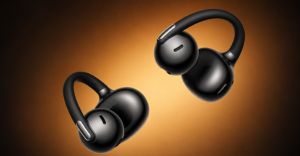
The Baseus Bowie MC2 Open-Ear True Wireless Earbuds earns the Best Value Clip-On Open-Wear Earbuds award because it combines adjustable clip cushions, a current $59.99 manufacturer list price, long battery life, and unusually broad codec support. The detachable medium, large, and extra-large air cushions give buyers more ways to adjust pressure and speaker position than a fixed one-size clip.
An 11 mm dynamic driver works with SuperBass 3.0 and directional vents to strengthen low frequencies while controlling leakage. Codec support includes the Subband Codec (SBC), AAC, and Sony’s Lossless Digital Audio Codec (LDAC), with LDAC offering the highest wireless bitrate on compatible Android devices. Each earbud weighs about 5.1 g, but correct clip placement still matters because moving the driver away from the ear can reduce bass and shift stereo balance; readers with fit concerns can also consult our small-ear earbud guide.
The open clip keeps speech and traffic audible and does not include ANC, so it favors movement, errands, and awareness over flights or noisy transit. Baseus rates playback at about 11.5 hours per charge and 55 hours total with Bass Boost, or 13 and 60 hours without it, under its stated laboratory conditions. Four beamforming microphones, Bluetooth 6.0, multipoint pairing, 38 ms low-latency mode, and IP67 protection on the earbuds give budget buyers a strong practical feature set.
View on Amazon: Baseus Bowie MC2 Open-Ear True Wireless Earbuds
5. JBL Sense Pro
Best Open-Wear Earbuds for Calls
- Uses four beamforming microphones and a dedicated Voice Pickup Sensor
- Supports a 16.2 mm driver, LDAC, adaptive bass processing, and Spatial Sound
- Provides adjustable split ear hooks for more precise driver positioning
- Delivers up to eight hours per charge and 38 hours with wireless case charging
- Substantial 11.6 g weight per earbud for users sensitive to hook pressure
- Moderate IP54 protection that trails more workout-focused alternatives
- Open acoustic path that cannot block surrounding conversations during calls
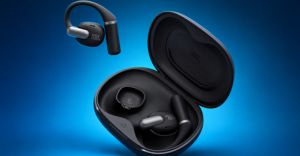
The JBL Sense Pro earns the Best Open-Wear Earbuds for Calls award because it combines two beamforming microphones per earbud with a Voice Pickup Sensor and an AI-trained environmental-noise algorithm. The sensor detects vibration associated with speech while the microphones capture the voice through the air, giving the processing system more information to separate the caller from wind and surrounding noise.
JBL uses a 16.2 mm diamond-like-carbon dynamic driver with a manufacturer-specified 20 Hz to 40 kHz response, LDAC support, and an adaptive bass algorithm that changes low-frequency processing with volume. Spatial Sound broadens stereo content, while Personi-Fi 3.0 and the JBL Headphones app provide personalized tuning and control customization. The adjustable split hooks help aim each driver toward the ear canal, although the 11.6 g weight makes careful adjustment important for avoiding concentrated pressure.
Sense Pro preserves nearby speech and traffic rather than isolating the listener, so the microphones can improve outgoing voice clarity without making a noisy room quiet for the wearer. JBL rates playback at eight hours per charge and 38 hours with the case, and a ten-minute charge supplies up to four hours. Bluetooth 6.0, multipoint, wireless charging, Fast Pair, and IP54 protection round out the call-focused package; persistent Bluetooth or microphone problems may also benefit from our headphone troubleshooting guide.
View on Amazon: JBL Sense Pro
6. Cleer ARC 5 Open-Ear Earbuds
Best Open-Wear Earbuds for Spatial Audio
- Combines THX Spatial Audio, head tracking, and Dolby Atmos optimization
- Supports aptX Lossless, aptX Adaptive, LDAC, LC3, AAC, and SBC
- Provides an AMOLED touchscreen case for playback, EQ, and battery controls
- Reaches up to 12 hours per charge, 60 hours total, and IPX7 protection
- Heavy 117 g combined package because of the feature-rich charging case
- Limited manufacturer-specified 65 Hz bass extension from the open acoustic design
- Two-microphone call system despite the premium entertainment focus
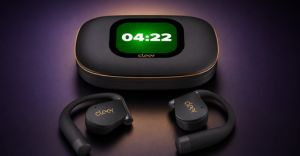
The Cleer ARC 5 Open-Ear Earbuds earns the Best Open-Wear Earbuds for Spatial Audio award because it combines THX Spatial Audio, dynamic head tracking, Dolby Atmos optimization, and an Active-Matrix Organic Light-Emitting Diode (AMOLED) touchscreen case. The case can manage playback, EQ, battery information, and other functions without requiring the phone for every adjustment, which makes the ARC 5 unusually self-contained.
Cleer specifies a 16.2 mm driver and a 65 Hz to 40 kHz Bluetooth response, so the design prioritizes open presentation and upper-frequency bandwidth rather than sealed-earbud sub-bass extension. THX processing and head tracking can anchor virtual sound objects as the listener turns, while the Cleer+ app supplies personalized EQ and control settings. Each earbud weighs 11.5 g, and the thinner ear hook aims to distribute that mass, but buyers should still expect a different fit from an in-ear model or the spacious full-size presentation discussed in our HIFIMAN Arya Stealth review.
The ARC 5 keeps the ear canal open, so its cinematic processing does not prevent traffic, voices, or room noise from entering naturally. Bluetooth 5.4 supports aptX Adaptive, aptX Lossless, LDAC, the Low Complexity Communication Codec (LC3), AAC, and SBC, while multipoint handles two-device workflows. Cleer rates battery life at 12 hours per charge and 60 hours total, with a ten-minute charge supplying four hours; IPX7 protection and two-microphone Qualcomm Clear Voice Capture (cVc) processing support workouts and calls.
View on Amazon: Cleer ARC 5 Open-Ear Earbuds
7. Nothing Ear (open)
Best Open-Wear Earbuds for EQ Control
- Offers an eight-band Advanced EQ with profile sharing through Nothing X
- Uses a 14.2 mm titanium-coated driver with automatic Bass Enhance
- Weighs 8.1 g per earbud and balances through a flexible three-point hook
- Provides eight hours per charge, 30 hours total, and dual-device connection
- Missing ANC for flights, trains, and concentrated work in loud rooms
- Limited AAC and SBC codec support without LDAC or aptX
- Wide 125.9 mm charging case that occupies more pocket space than compact cases
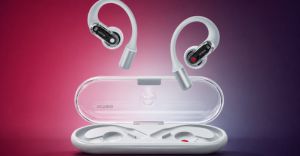
The Nothing Ear (open) earns the Best Open-Wear Earbuds for EQ Control award because the Nothing X app provides an eight-band Advanced EQ, sharable profiles, Bass Enhance, and customizable controls. That combination gives users more direct tonal control than adaptive-only systems and makes it easier to create separate curves for podcasts, music, and low-volume listening.
Nothing positions a 14.2 mm titanium-coated driver at a 50-degree angle and uses a stepped structure to move the sound source closer to the ear. Bass Enhance adjusts low-frequency processing automatically, while the eight-band EQ can reduce broad warmth, lift vocal presence, or soften upper-frequency energy without forcing one preset. A flexible nickel-titanium hook and three-point balance support the 8.1 g earbud, but open positioning still produces a different bass foundation and sense of space from the over-ear design in our HIFIMAN Arya Stealth assessment.
Ear (open) uses directional speakers and a Sound Seal System to limit outward leakage, but it intentionally leaves environmental sound accessible and provides no ANC. Nothing rates playback at eight hours per charge and 30 hours with the case, plus six and 24 hours of talk time. Bluetooth 5.3, AAC, SBC, two microphones with AI Clear Voice processing, IP54 protection for the buds and case, pinch controls, Fast Pair, Swift Pair, and dual connection cover broad daily use.
View on Amazon: Nothing Ear (open)
What to Look for in Open Wear Stereo Earbuds
Choose the Right Wearing Style: Ear hooks place the speaker beside the canal and distribute weight around the outer ear, while clip-on models grip the ear from two sides. Semi-open buds such as AirPods 4 rest closer to the canal without creating a silicone-tip seal.
Consider glasses, ear shape, jewelry, helmets, and the amount of movement involved in daily use. Adjustable hooks and replaceable clip cushions provide more fit flexibility, while a fixed universal shell depends more heavily on matching the buyer’s anatomy.
Check Directional Sound and Leakage: Open-wear earbuds need to direct sound toward the canal because they cannot rely on a sealed acoustic chamber. Technologies such as DirectPitch, JBL OpenSound, and Nothing’s Sound Seal System use driver position or opposing waves to reduce how much audio escapes toward nearby people.
No directional system guarantees complete privacy in a quiet office, library, or shared bedroom. Buyers who frequently listen around other people should keep the volume moderate and compare leakage controls rather than relying only on driver size.
Match Bass Expectations to the Open Design: An open ear canal allows low-frequency energy to escape, so even a large driver may not reproduce sub-bass with the same physical weight as a sealed earbud. Bass algorithms and EQ can restore warmth and punch, but extreme boosts reduce headroom and may increase distortion.
If deep bass and maximum isolation matter more than awareness, a sealed model may suit the use case better. Our Bose QuietComfort Earbuds II review explains how a closed ear-tip seal changes bass consistency and noise reduction.
Compare Battery and Charging Behavior: Manufacturer totals combine the earbuds and every recharge stored in the case, so the single-charge figure matters more during long runs, work shifts, or flights. Noise reduction, spatial processing, high-bitrate codecs, louder volume, and call use can all shorten the published maximum.
Check whether the case supports USB-C, wireless charging, or both, and compare quick-charge performance for last-minute use. A larger 50-hour or 60-hour case may also occupy more pocket space than a compact 20-hour or 30-hour alternative.
Evaluate Calls and Connectivity: Microphone count alone does not determine call clarity because placement, wind protection, beamforming, and voice-detection algorithms also matter. Open designs let the listener hear surrounding speech naturally, but that same awareness can make incoming calls harder to follow in a crowded environment.
Multipoint helps users switch between a phone and computer, while Fast Pair and platform integration reduce setup time. If calls sound distorted or one side repeatedly disconnects, reset the pairing and use our headphone troubleshooting guide before assuming the microphones have failed.
Protect Volume and Outdoor Awareness: Open-wear earbuds can reduce social isolation and keep traffic cues audible, but awareness depends on playback volume and the surrounding noise level. A loud song can still mask a bicycle bell, vehicle, alarm, or spoken warning.
The WHO safe-listening standard for gaming and esports notes that maximum EQ settings can increase headphone output voltage and Sound Pressure Level (SPL). Reduce the master level before applying strong positive EQ gain, take listening breaks, and never treat an open-ear design as certified hearing protection.
Frequently Asked Questions
Are Open-Wear Earbuds Safer Than In-Ear Earbuds?
Open-wear earbuds keep the canal unobstructed and can preserve more awareness of traffic, speech, and alarms. They do not automatically protect hearing, however, because high playback levels and long exposure can still cause harm.
Can Open-Wear Earbuds Provide Effective Noise Cancelation?
AirPods 4 with ANC and Shokz OpenFit Pro use microphones and processing to reduce selected environmental sounds without a silicone seal. Their open designs generally retain more voices and high-frequency noise than sealed ANC earbuds, which is useful for awareness but less suitable for maximum quiet.
Do Ear Hooks Work Comfortably With Glasses?
Many users can wear ear-hook earbuds with glasses, but comfort depends on the thickness of the glasses arm, ear shape, hook flexibility, and speaker position. A thin adjustable hook or clip-on design may reduce competition for space, but buyers should use a retailer with a practical return policy when fit remains uncertain.
Do Open-Wear Earbuds Leak Sound?
All open designs can leak some sound because the driver operates outside a sealed canal. Directional audio systems reduce leakage, but nearby people may still hear treble and vocals at high volume in a quiet room.
Final Verdict
The Shokz OpenFit Pro is the strongest overall choice because it combines a large dual-diaphragm driver, five EQ presets, two custom profiles, open-ear noise reduction, Dolby Atmos optimization with head tracking, multipoint, IP55 protection, and up to 50 hours of total battery life. Buyers should choose it when sound features and environmental control matter more than obtaining the lightest or least expensive option.
Apple users receive the smoothest ecosystem experience from the ANC configuration of AirPods 4, while Shokz OpenFit 2+ offers the lighter all-day alternative with dual-driver sound and 48-hour total battery life. JBL Sense Pro stands out for calls, and Cleer ARC 5 offers the most ambitious spatial-audio package with head tracking, broad codec support, a touchscreen case, and 60 hours of total playback.
Baseus Bowie MC2 supplies the strongest value through adjustable clip cushions, LDAC, IP67 protection, and long battery life. Nothing Ear (open) gives tuning-focused buyers the best manual EQ system in this group. Make the final decision around fit, environmental awareness, leakage, single-charge endurance, call needs, and device compatibility rather than assuming every open-wear design behaves the same way.