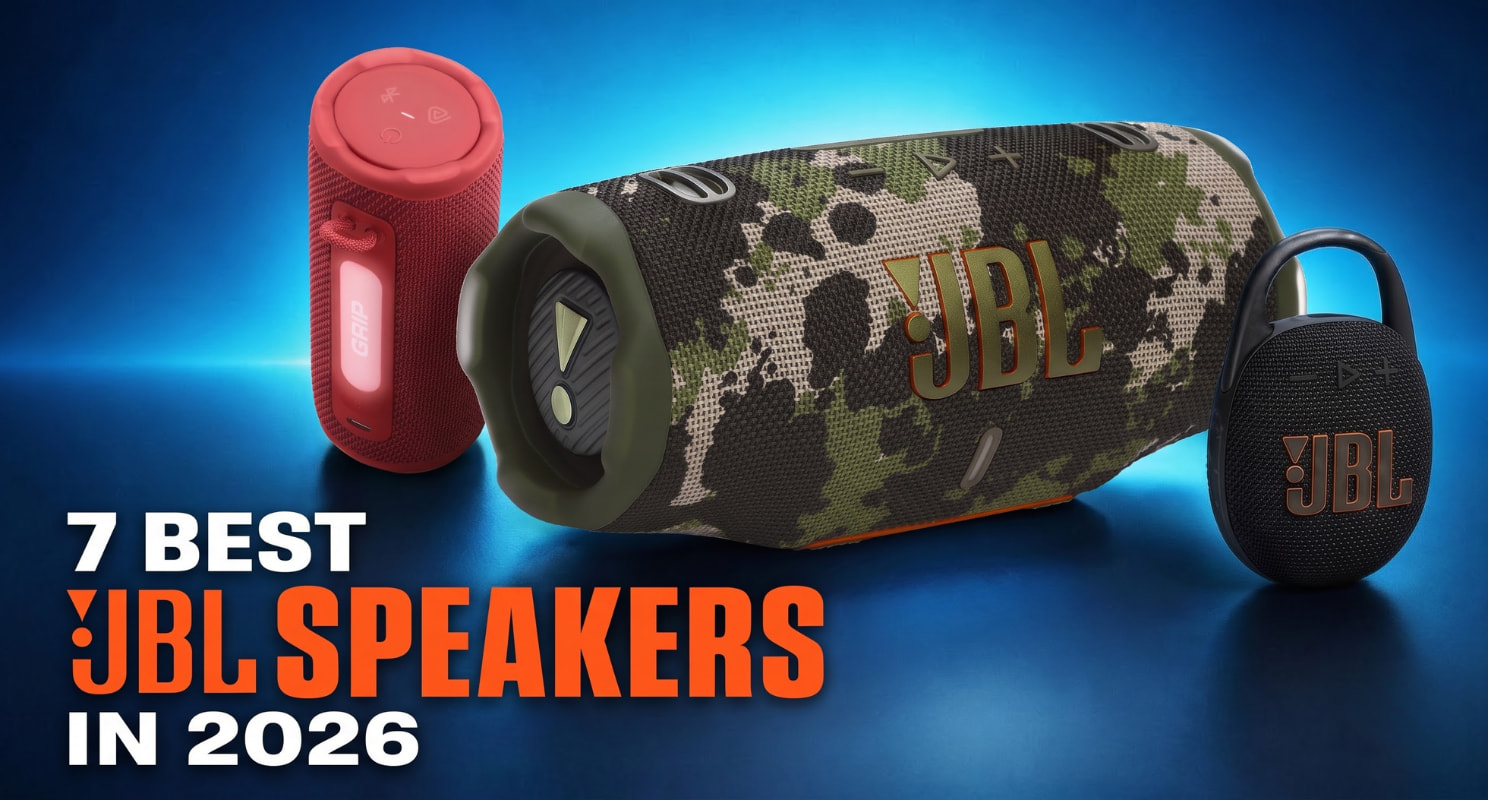
JBL’s current portable speaker range covers everything from the 0.51-pound Go 5, built for pockets and small bags, to the 13-pound Boombox 4, designed to deliver substantially higher output for parties and large outdoor spaces. That broad selection makes choosing the right model more complicated than simply buying the newest or most powerful speaker. Listening volume also deserves consideration: the World Health Organization’s safe-listening guidance says 80 Decibels (dB) can be safe for up to 40 hours per week, while raising the level to 90 dB reduces that time to only four hours.
We compared all seven requested JBL speakers using current official specifications, including driver configurations, Root Mean Square (RMS) output, frequency-response ranges, battery claims, dimensions, carrying systems, connection standards, and Ingress Protection (IP) ratings. We also considered how those specifications should affect bass extension, vocal clarity, soundstage width, outdoor audibility, carrying comfort, and everyday usability. The rankings therefore focus on how well each speaker fits a particular listening situation rather than rewarding the model with the highest wattage or longest advertised battery life.
The JBL Charge 6 offers the strongest all-around balance for most buyers because it combines 45 watts RMS, a 24-hour standard battery rating, IP68 protection, a removable carrying strap, and a built-in phone-charging power bank. Different priorities produce different winners, however. Hikers may prefer the carabiner-equipped Clip 5, travelers and bedroom listeners may value the smaller Go 5 or Flip 7, while backyard hosts may need the additional output of the Xtreme 5 or Boombox 4. Readers upgrading from an older speaker can also use our JBL Charge and Flip comparison to understand how these two popular JBL families differ in size, output, and intended use.
Quick Overview for JBL Speakers
| Overall Best | JBL Charge 6 |
| Best Budget Option | JBL Go 5 |
| Best for Hiking | JBL Clip 5 |
| Best for Mood Lighting | JBL Grip |
| Best Compact Sound | JBL Flip 7 |
| Best for Outdoor Parties | JBL Xtreme 5 |
| Best for Maximum Output | JBL Boombox 4 |
In-Depth Look: JBL Speakers
1. JBL Charge 6
Overall Best
- Combines a 30-watt woofer and 15-watt tweeter for 45 watts of Root Mean Square (RMS) output.
- Extends rated playback from 24 hours to 28 hours with Playtime Boost.
- Charges a phone through the built-in power bank while music continues.
- Carries an Ingress Protection (IP) rating of IP68 for water and dust resistance.
- Links compatible speakers through Auracast for stereo or wider multi-speaker coverage.
- 2.18-pound carrying weight with the removable strap attached
- Lack of a listed 3.5 mm analog audio input
- Single-cabinet imaging that needs a second speaker for true stereo separation
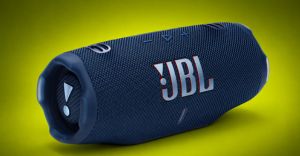
The JBL Charge 6 earns the Overall Best award because it combines meaningful output, long battery life, rugged construction, and phone charging without becoming difficult to carry. It sits between the lighter Flip 7 and the much heavier Xtreme 5, which makes it the most adaptable choice for kitchens, patios, hotel rooms, and day trips.
Its 53 x 93 mm woofer and separate 20 mm tweeter split bass and upper-frequency work more effectively than a single full-range driver. The published 56 Hertz (Hz) to 20 Kilohertz (kHz) response suggests solid kick-drum weight and clearer vocal edges, although listeners should not expect true sub-bass from this compact enclosure. A single unit creates a centered, mostly mono presentation, while an Auracast stereo pair can widen the soundstage and improve left-to-right instrument placement.
At 9.0 x 3.9 x 3.7 inches, the Charge 6 remains easy to place, and the removable strap reduces hand strain during longer walks. Its 45-watt output provides useful headroom when conversation, an office fan, or light outdoor noise masks quieter details, but nearby speech will still compete at low volume. JBL rates it for IP68 protection, a one-meter drop onto concrete, 24 hours of standard playback, four extra boost hours, and up to 150 minutes from a 10-minute fast charge. Our waterproof speaker guide explains why protection ratings still require sensible care.
View on Amazon: JBL Charge 6
2. JBL Go 5
Best Budget Option
- Fits into small bags with a 0.51-pound body and palm-sized footprint.
- Supports Bluetooth 6.0 with Low Complexity Communications Codec (LC3) playback.
- Streams lossless audio from compatible sources through Universal Serial Bus Type-C (USB-C).
- Pairs two units instantly through AirTouch or joins larger Auracast groups.
- Survives wet and dusty trips with an IP68 rating and drop-resistant shell.
- 100 Hz low-frequency limit that restricts deep bass extension
- Eight-hour standard battery rating before Playtime Boost
- Missing charging cable in the retail box
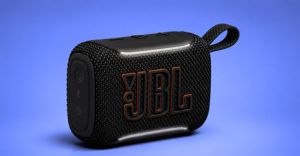
The JBL Go 5 earns the Best Budget Option award because it brings JBL’s newest connectivity, app control, lighting, and ruggedness to the smallest and most accessible form factor in this group. Its 3.98 x 3.05 x 1.7-inch body works well for desks, carry-on bags, and casual listening where size matters more than room-filling power.
A 45 mm driver produces 4.8 watts RMS across a stated 100 Hz to 19 kHz range. That tuning should keep speech, acoustic guitar, and pop vocals intelligible, but bass fundamentals below 100 Hz will rely more on harmonic impression than physical extension. The seven-band Equalization (EQ) control can shape warmth or treble presence, while two Go 5 speakers provide real stereo separation through AirTouch.
The flat, lightweight shell creates almost no carrying fatigue and occupies less space than the Clip 5’s taller carabiner design. In a quiet bedroom or office, its modest output should remain clear. Traffic, a loud extractor fan, or a crowded picnic can mask bass and low-level detail quickly. JBL rates the battery for eight hours with lighting off plus two boost hours, and the IP68 shell suits splash-prone areas. Buyers comparing similarly small models should also review our compact shower speaker picks.
View on Amazon: JBL Go 5
3. JBL Clip 5
Best for Hiking
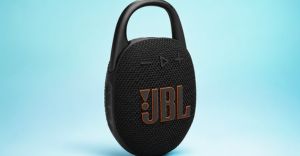
- Attaches securely to straps and loops through a wide integrated carabiner.
- Delivers 7 watts RMS from a 45 mm driver and passive radiator.
- Runs for up to 12 hours plus three Playtime Boost hours.
- Resists water and dust with an IP67 rating.
- Connects two Clip 5 units in stereo or multiple compatible speakers through Auracast.
- 95 Hz bass floor that limits low sub-bass fundamentals
- Three-hour charging time from a 5-volt, 1-ampere source
- IP67 protection that trails the IP68 rating of newer JBL models
The JBL Clip 5 earns the Best for Hiking award because its built-in carabiner solves the most important trail problem: carrying a speaker without using a hand or sacrificing easy access. At 0.628 pounds, it adds little weight to a backpack, belt loop, or day bag while offering a longer standard battery rating than the Go 5.
Its 45 mm transducer and passive radiator deliver 7 watts RMS over a 95 Hz to 20 kHz range. The radiator should add mid-bass punch to drums and bass guitar, but the 95 Hz limit still places deep electronic notes outside the speaker’s strongest range. Vocals should remain central and easy to follow, while stereo pairing offers a more spacious image and better instrument separation at camp.
The larger carabiner opening improves attachment flexibility, although the tall 5.3-inch body can swing against a pack during fast movement. An IP67 rating protects against dust and water under controlled test conditions, but users should dry the charging area before connecting power. Wind, trail noise, and group conversation can obscure its lower frequencies, so place it close to listeners rather than chasing maximum volume. People who need private sound and environmental awareness can compare our outdoor-work earbud guide.
View on Amazon: JBL Clip 5
4. JBL Grip
Best for Mood Lighting
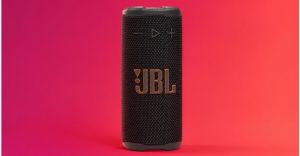
- Creates adjustable ambient color themes from an integrated rear light.
- Produces 16 watts RMS through a 43 x 80 mm full-range driver.
- Customizes sound through a seven-band EQ in the JBL Portable app.
- Withstands dust, water, and one-meter drops with an IP68-rated build.
- Expands playback from 12 hours to 14 hours with Playtime Boost.
- Single full-range driver that limits stereo imaging and driver separation
- 70 Hz low-end limit that favors punch over true sub-bass
- Upright 6-inch form that lacks the Clip 5’s integrated carabiner
The JBL Grip earns the Best for Mood Lighting award because its adjustable rear illumination adds useful atmosphere without turning the speaker into a large party box. Its upright shape and 0.849-pound weight fit shelves, nightstands, yoga spaces, and small patios where both appearance and compactness matter.
The 43 x 80 mm full-range driver supplies 16 watts RMS across 70 Hz to 20 kHz, giving it more bass reach and output headroom than the Go 5 or Clip 5. With one driver, vocals and instruments share the same acoustic source, so separation remains more compact than on the two-way Flip 7. The seven-band EQ helps reduce excess warmth near walls or add presence for podcasts without relying on a generic preset.
Its narrow cylindrical body allows a full-hand grip, but there is no built-in carabiner for hands-free attachment. The IP68 body and published one-meter drop resistance suit busy rooms and outdoor tables, while 12 standard hours plus two boost hours cover a full day. Its 16-watt output should remain intelligible over keyboard clatter or an office fan, but group conversation can mask bass outdoors. For a quiet-room setup centered on bedside features rather than rugged portability, our bedroom speaker guide covers several alternatives.
View on Amazon: JBL Grip
5. JBL Flip 7
Best Compact Sound
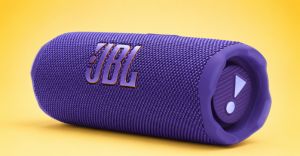
- Separates bass and treble through a 25-watt woofer and 10-watt tweeter.
- Reaches a stated 60 Hz low-frequency limit from a 1.23-pound enclosure.
- Plays lossless audio from compatible sources over USB-C.
- Includes loop and carabiner accessories through the PushLock system.
- Handles water, dust, and one-meter drops with an IP68-rated chassis.
- 14-hour standard battery rating below the Charge 6 and larger models
- Missing phone-charging power bank found on the Charge 6
- Lack of a listed 3.5 mm analog audio input
The JBL Flip 7 earns the Best Compact Sound award because it packs a dedicated woofer and tweeter into a 7.19-inch body that remains genuinely portable. It offers a clearer step up in acoustic capability from the one-driver Go 5, Clip 5, and Grip without crossing into the two-pound weight class.
A 45 x 80 mm woofer handles 25 watts RMS, while a 16 mm tweeter receives another 10 watts RMS. The 60 Hz to 20 kHz range suggests stronger bass-guitar body, cleaner vocal articulation, and smoother cymbal detail than the smaller models, although the compact cabinet still cannot reproduce the lowest sub-bass octave with authority. One Flip 7 centers the image, but an Auracast stereo pair can create real channel width and more distinct instrument positions.
The PushLock loop and included carabiner give buyers more carrying choices than a fixed strap, and the 1.23-pound weight remains manageable for day bags. IP68 protection and one-meter drop resistance strengthen its outdoor case, while the 14-hour standard battery plus two boost hours suits day trips rather than multi-day use. Its 35-watt output can push through moderate conversation and patio noise more convincingly than the pocket models. For louder vehicle-side gatherings, see our tailgate speaker guide.
View on Amazon: JBL Flip 7
6. JBL Xtreme 5
Best for Outdoor Parties
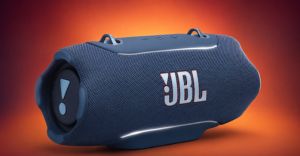
- Produces 90 watts RMS on battery power and 130 watts RMS on external power.
- Extends low-frequency response to 40 Hz through a large woofer and dual tweeters.
- Runs for 24 hours plus four Playtime Boost hours.
- Charges mobile devices through an integrated power bank.
- Adds IP68 protection, ambient lighting, Auracast, and lossless USB-C playback.
- 6.38-pound weight that makes the shoulder strap necessary for longer carries
- 3.5-hour full charging time
- Lower 90-watt output on battery than the 130-watt external-power rating
The JBL Xtreme 5 earns the Best for Outdoor Parties award because it offers a large increase in bass capability and output while remaining shoulder-portable. It targets buyers who find the Charge 6 too restrained for groups but do not want the Boombox 4’s 13-pound weight and oversized handle.
Its 98 x 145 mm woofer and two 20 mm tweeters produce 90 watts RMS on battery or 130 watts RMS in Alternating Current (AC) power mode. A 40 Hz to 20 kHz range gives bass drums and electronic tracks more physical weight, while the dual tweeters support clearer high-frequency spread. Smart EQ Mode can adjust processing for speech or music, and a second Xtreme 5 can form a wider stereo stage through Auracast.
The adjustable shoulder strap and floating hooks distribute its 6.38-pound weight better than a bare handle, though it remains too heavy for casual backpacking. Outdoors, the additional output provides more margin against chatter, wind, and open-space bass loss than the Charge 6, while IP68 and drop-resistant construction address rain, dust, and accidental bumps. JBL rates playback at 24 hours plus four boost hours and lists a 10-minute charge for two extra hours, making it a stronger all-day event choice than smaller models in our loud Bluetooth speaker guide.
View on Amazon: JBL Xtreme 5
7. JBL Boombox 4
Best for Maximum Output
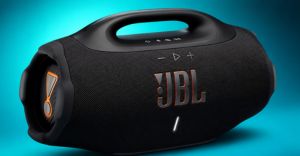
- Delivers 200 watts RMS on battery and 210 watts RMS on AC power.
- Reaches a stated 37 Hz through two five-inch woofers and three passive radiators.
- Switches between Deep Bass and Punchy Bass modes from the top panel.
- Extends rated playback from 28 hours to 34 hours with Playtime Boost.
- Supports IP68 protection, Auracast, lossless USB-C audio, and a replaceable battery.
- 13-pound weight that limits walk-around portability
- 19.9-inch width that demands substantial shelf, trunk, or table space
- Lack of a listed 3.5 mm analog audio input
The JBL Boombox 4 earns the Best for Maximum Output award because no other model in this group matches its combination of amplifier power, bass extension, battery endurance, and large-driver area. It suits backyards, tailgates, and big rooms where coverage matters more than one-handed portability.
Two 123 mm woofers and two 20 mm tweeters produce 200 watts RMS on battery, with AC power raising the total to 210 watts RMS. The 37 Hz to 20 kHz range reaches deeper than the Xtreme 5, and three passive radiators reinforce low-frequency energy. Deep Bass mode favors low-end weight, while Punchy Bass mode should tighten rhythmic impact. A single cabinet remains a centered source, and pairing two units through Auracast creates the strongest stereo scale.
The integrated handle makes short transfers practical, but 13 pounds and a 19.9 x 10.4 x 8.4-inch frame call for trunk space and a stable surface. Its power and larger radiating area offer the best chance of preserving bass and vocal clarity against a lively crowd or outdoor ambience, yet close-range listening still requires sensible volume. JBL rates the IP68 battery-powered design for 28 hours plus six boost hours, and the replaceable battery can extend service life beyond the original pack.
View on Amazon: JBL Boombox 4
What to Look for in JBL Speakers
Matching Output to Space: Small rooms and close-range listening do not need party-speaker power, and excessive output can make volume control harder at a desk or bedside. The Go 5 and Clip 5 suit personal listening, while the Flip 7 and Charge 6 provide more headroom for kitchens, patios, and small gatherings. Larger groups and open outdoor spaces benefit from the Xtreme 5 or Boombox 4 because their higher RMS output has a better chance of overcoming conversation, wind, and open-air sound loss.
Comparing Bass Extension: A lower frequency-response limit generally allows a speaker to reproduce deeper notes, but driver size, cabinet volume, passive radiators, and tuning also influence the final result. The Go 5 and Clip 5 prioritize portability, so they emphasize audible mid-bass punch rather than the physical low-frequency weight available from the Xtreme 5 or Boombox 4. Placement matters too, as positioning a speaker near a wall can reinforce bass, while placing it in an open area may make the same speaker sound leaner.
Checking Battery Endurance: JBL separates standard playback from Playtime Boost, which extends runtime by adjusting the speaker’s performance and power consumption. Compare standard battery life first, then treat the additional boost hours as a reserve because higher volume, lighting effects, phone charging, wireless conditions, and bass-heavy music can reduce real-world playback time. Buyers who spend full days outdoors should also consider charging speed, power-bank functionality, and whether the battery can be replaced when its capacity eventually declines.
Assessing Carrying Comfort: Weight alone does not determine portability because the speaker’s shape and carrying accessories can make a substantial difference during travel. The Clip 5 provides an integrated carabiner, the Flip 7 uses interchangeable carrying accessories, the Charge 6 includes a removable hand strap, and the Xtreme 5 uses a shoulder strap to distribute its heavier load. The 13-pound Boombox 4 works best for short transfers between a vehicle and a stable surface rather than hiking, commuting, or extended one-handed carrying.
Confirming Weather Protection: An IP67 or IP68 rating supports outdoor use by indicating tested resistance to water and dust under controlled conditions. The Clip 5 carries an IP67 rating, while the Go 5, Grip, Flip 7, Charge 6, Xtreme 5, and Boombox 4 carry IP68 ratings, but neither rating makes an exposed charging port safe around water. Dry the speaker before connecting a cable, avoid unnecessary immersion, and remember that drops, worn seals, and long-term use can reduce protection; our outdoor speaker guide covers more permanent yard installations.
Verifying Pairing Compatibility: All seven models support Auracast, allowing compatible JBL speakers to join a wider wireless speaker group. Creating a true left-and-right stereo pair generally requires two matching models, while mixed compatible models may operate as a synchronized multi-speaker group rather than a stereo pair. Review app support, pairing instructions, and firmware status before buying multiple units; the Bluetooth Special Interest Group’s Auracast overview explains how the underlying broadcast-audio system operates.
Frequently Asked Questions
Which JBL Speaker Is Best Overall in 2026?
The JBL Charge 6 is the best overall choice for most buyers because it balances 45 watts RMS, a 24-hour standard battery rating, IP68 protection, a carry strap, and phone charging. Buyers who need much higher output should move to the Xtreme 5 or Boombox 4.
Can These JBL Speakers Connect to One Another?
All seven listed models support Auracast, which allows compatible JBL speakers to join a wider group. Stereo pairing normally uses two matching models, so check the app and current firmware before assuming two different speakers will form left and right channels.
Are JBL Speakers Fully Waterproof?
The Clip 5 carries an IP67 rating, while the Go 5, Grip, Flip 7, Charge 6, Xtreme 5, and Boombox 4 carry IP68 ratings. These codes describe controlled water and dust tests, not permission to charge a wet speaker or expose seals to unlimited wear.
Can One JBL Speaker Replace a Stereo System?
A single portable speaker offers convenience and strong central coverage, but it cannot create the same physical channel separation as two speakers placed apart. Pairing two matching Auracast models improves width, while buyers who prioritize precise imaging at home should compare dedicated bookshelf speaker systems and understand the differences between active and passive speakers.
Final Verdict
The JBL Charge 6 gives most buyers the strongest overall balance of sound capability, battery endurance, durability, and manageable size. Its separate woofer and tweeter produce 45 watts Root Mean Square (RMS), giving music more bass weight and output headroom than the smaller Go 5, Clip 5, and Grip. A 24-hour standard battery rating, IP68 protection, removable carrying strap, fast charging, Auracast support, and a built-in power bank make it suitable for home listening, travel, patios, and day-long outdoor use without the weight of a full party speaker.
Buyers who prioritize portability have several better-targeted alternatives. The Go 5 offers the smallest and most affordable entry point for desks, bedrooms, hotel rooms, and light travel, while the Clip 5 adds an integrated carabiner for backpacks and hiking gear. The Grip suits listeners who want customizable ambient lighting and stronger output than the pocket models, while the Flip 7 delivers the best compact sound through its dedicated woofer and tweeter without crossing into the heavier two-pound category.
For larger gatherings, the Xtreme 5 provides substantially more output and deeper bass while remaining transportable with its shoulder strap. The Boombox 4 goes further with the highest power, deepest stated bass extension, longest boosted battery rating, and largest drivers in this group, but its 13-pound weight makes it better suited to backyards, tailgates, and vehicle-supported trips. Choose the Charge 6 if you want one adaptable JBL speaker for most situations, then move smaller for convenience or larger when maximum coverage and bass impact matter more than carrying comfort.